Word Flesh

Pre/face © Denise Startin

FLASH – an instant of time or a timeless dream; atoms swollen beyond measure, atoms of a bond, a vision, a shiver, a still shapeless embryo, unnameable. Photo’s of what is not yet visible and which language necessarily surveys, from a very high altitude elusively. Words always too remote, too abstract to capture the subterranean swarm of seconds, insinuating themselves into unimaginable places.

Writing them down tests an argument, as does love. What is love for a woman, the same thing as writing. Laugh. Impossible. Flash of the unnamable, woven of abstractions to be torn apart. Let a body finally venture out of its shelter, expose itself in meaning beneath a veil of words. WORD FLESH.  From one to the other, eternally, fragmented visions, metaphors of the invisible.”

Stabat mater, Julia Kristeva quoted in The Female Body in Western Culture: Contemporary Perspectives, Susan Rubin Suleiman, Harvard University Press, 1986 p.99/100

The Flesh of Words > Derma[uto]graphic drifts

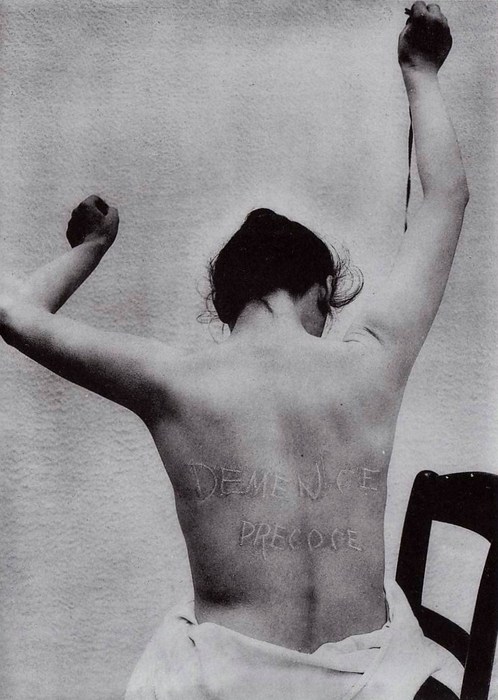
Dermographisme [aka dermographism, dermatographismm or “skin writing] – Démence précoce catatonique, from Nouvelle Iconographie de la Salpêtrière, Paris, 1904.

“Language is understood by Merleau-Ponty according to the self enfolding of the flesh. Language is not dependent on any voice but is what gives voice to the world itself. He writes that “language is everything since it is the voice of no-one, since it is the very voice of the things, the waves and the forests.” Language, in short, is the result of or is made possible by the dehiscence or folding back of the flesh of the world. [Invagination?]. In this sense language too is ‘another flesh’, another ‘wild being.’ Continue reading

Not all those who wander are lost

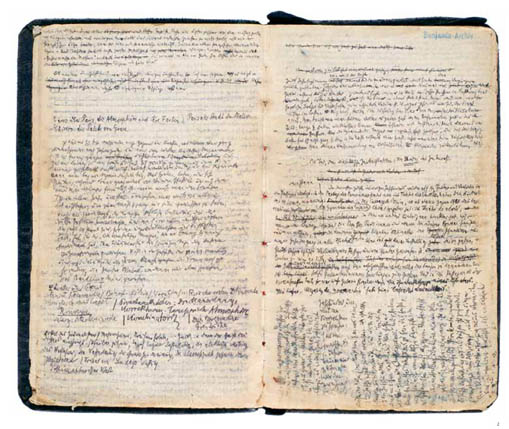
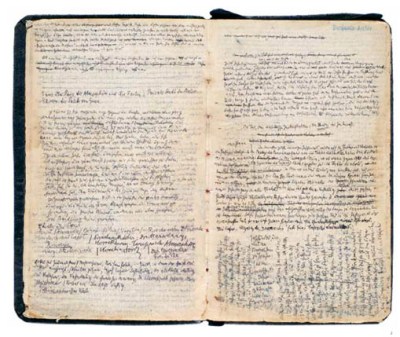
Walter Benjamin, Pariser Passagen

In the Field Guide To Getting Lost Rebecca Solnit quotes a question from the pre-socratic philosopher Meno. “How will you go about finding that thing the nature of which is totally unknown to you?” p.4 […] and goes on to write “To lose yourself: a voluptuous surrender, lost in your arms, lost to the world, utterly immersed in what is present so that its surroundings fade away. In Benjamin’s terms, to be lost is to be fully present, and to be fully present is to be capable of being in uncertainty and mystery. And one does not get lost but loses oneself, with the implication that it is a conscious choice, a chosen surrendering, a psychic state achievable through geography.” p.6

The current exhibition at the British Library 25th September celebrates this psychic state through the relationship of writing in Britain. Exhibits include extracts from diaries, notebooks, letters, artworks and sound recordings from a wealth of poets and writers including William Blake, Ted Hughes, George Eliot, James Joyce, J G Ballard, John Lennon, Harold Pinter and more. Writing speaks of walking and wandering [wondering], of finding and losing, of coming and going, of boundaries and horizons, pilgrimages and wild places. Writing and landscape mark each other reciprocally producing dream landscapes, barren landscapes, hostile landscapes, loving landscapes and sacred spaces where the human being who is most of the time caught up in human doing, can take time out and dwell [in the Heideggerian sense of the term] in being. To experience its chthonic heartbeat and return itself to its natural rhythms through walking and what is writing if not a walk on the wild side?

The title of this quote is reproduced from the exhibition and is from J.R.R. Tolkien, The Fellowship of the Ring.

Quotes reproduced from Rebecca Solnit, A Field Guide to Getting Lost, Canongate Books 2011. Image reproduced from http://www.hatjecantz.de/controller.php?cmd=detail&titzif=00002894&lang=en
Material Thinking

“the anti-architectural conception of place making is not a rejection of shelter as such. It is a search for a form of home more adequate to the process of becoming oneself at that place.”

Carter, Paul, Material Thinking: the theory and practice of creative research, Melbourne University Publishing, 2004: pp.154