The Flesh of Words > Derma[uto]graphic drifts

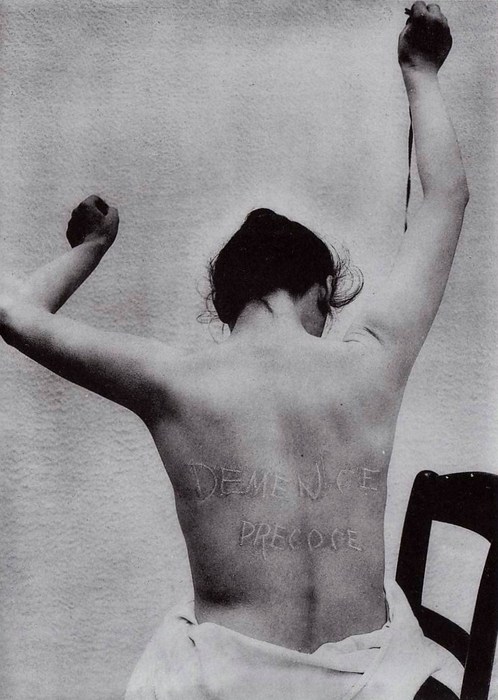
Dermographisme [aka dermographism, dermatographismm or “skin writing] – Démence précoce catatonique, from Nouvelle Iconographie de la Salpêtrière, Paris, 1904.

“Language is understood by Merleau-Ponty according to the self enfolding of the flesh. Language is not dependent on any voice but is what gives voice to the world itself. He writes that “language is everything since it is the voice of no-one, since it is the very voice of the things, the waves and the forests.” Language, in short, is the result of or is made possible by the dehiscence or folding back of the flesh of the world. [Invagination?]. In this sense language too is ‘another flesh’, another ‘wild being.’ Continue reading

Not all those who wander are lost

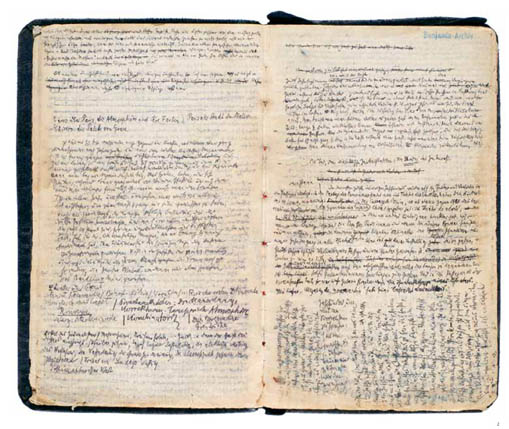
Walter Benjamin, Pariser Passagen

In the Field Guide To Getting Lost Rebecca Solnit quotes a question from the pre-socratic philosopher Meno. “How will you go about finding that thing the nature of which is totally unknown to you?” p.4 […] and goes on to write “To lose yourself: a voluptuous surrender, lost in your arms, lost to the world, utterly immersed in what is present so that its surroundings fade away. In Benjamin’s terms, to be lost is to be fully present, and to be fully present is to be capable of being in uncertainty and mystery. And one does not get lost but loses oneself, with the implication that it is a conscious choice, a chosen surrendering, a psychic state achievable through geography.” p.6

The current exhibition at the British Library 25th September celebrates this psychic state through the relationship of writing in Britain. Exhibits include extracts from diaries, notebooks, letters, artworks and sound recordings from a wealth of poets and writers including William Blake, Ted Hughes, George Eliot, James Joyce, J G Ballard, John Lennon, Harold Pinter and more. Writing speaks of walking and wandering [wondering], of finding and losing, of coming and going, of boundaries and horizons, pilgrimages and wild places. Writing and landscape mark each other reciprocally producing dream landscapes, barren landscapes, hostile landscapes, loving landscapes and sacred spaces where the human being who is most of the time caught up in human doing, can take time out and dwell [in the Heideggerian sense of the term] in being. To experience its chthonic heartbeat and return itself to its natural rhythms through walking and what is writing if not a walk on the wild side?

The title of this quote is reproduced from the exhibition and is from J.R.R. Tolkien, The Fellowship of the Ring.

Quotes reproduced from Rebecca Solnit, A Field Guide to Getting Lost, Canongate Books 2011. Image reproduced from http://www.hatjecantz.de/controller.php?cmd=detail&titzif=00002894&lang=en

Material Thinking

“the anti-architectural conception of place making is not a rejection of shelter as such. It is a search for a form of home more adequate to the process of becoming oneself at that place.”

Carter, Paul, Material Thinking: the theory and practice of creative research, Melbourne University Publishing, 2004: pp.154

French Horn with Mouse

“Can you ever forgive me for posting this delightfully corny image?” I had almost forgotten how I got here and then realised it had been produced by a search for images of Rebecca Horn. Hence a combination of surrealist chance and google images produced French Horn with Mouse [or Mouse with French Horn].

John Cale of the Velvet Underground is playing in the background [Fragments of a Rainy Season] and I am reading about writing, techné and female sexuality and this image provided a little light-hearted relief. Could it be that somewhere deep in Dissertation Land there is a mouse playing a french horn?.

Image reproduced from http://rakstagemom.wordpress.com/tag/the-nutcracker/ [there is very little here about the genesis of this image.]