A Lovers Discourse

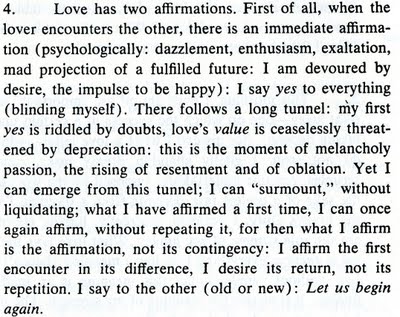
Excerpt from A Lovers Discourse

A Lovers Discourse by Roland Barthes consists of a peripatetic fragmentary writing which explores the ‘extreme solititude’ that is a lovers discourse evicted  by authoritative discourses, placed outside as it were, yet perhaps spoken by ‘thousands of subjects’. It is as Barthes explains a structural portrait of ‘someone speaking within himself, amorously, confronting the other [the loved object], who does not speak. Barthes takes us on a discursive journey, a performative utterance and structure of address to the other through absence, affirmation, waiting, circumscribing, contingencies, bodies, declaration, embrace, image, the unknowable, langour and silence. Continue reading

Poetry, Language, Thought

‘In Heidegger’s thinking, poetry is not a mere amusement or form of culture but a force that opens up the realm of truth and brings man to the measure of his being and his world.’

Quote from back cover, Extract from Poetry, Language, Thought, The Thinker as Poet, Harper and Row, NY 1971: pp11

Deleuze

First Drafts_DS 2012


“Writing has nothing to do with signifying. It has to do with surveying, mapping, even realms that are yet to come.”
Deleuze and Guattari, A Thousand Plateaus

Text reproduced from POSTCOLONIAL ‘TEXTUAL SPACE’: TOWARDS AN APPROACH
 by Alexander Moore . For the full article click here.


Dark Writing

Klee_Line_for_a_walk

“Conspicuously left out of geography’s line – as it is left out of Descartes construction of the ‘I’- is of course the body that writes, and which, in writing, is also being written. Justine Clark explains:

The surface of the drawing is the site of involuntary traces, just as the scene of the body is the scene of involuntary muscular motions – blushing, tics, twitches – the play of internal effects across the surface of the body. If we follow Elizabeth Grosz’s contention that ‘all effects of depth and interiority can be explained in terms of the inscriptions and transformations of the subject’s corporeal surface…that the body can be understood as the very stuff of subjectivity,” then this surface of bruises and blushes, tingles and scars is crucial.”

Carter Paul, Dark Writing, University of Hawaii Press, 2009:pp.82. Image reproduced from http://rodcorp.typepad.com/rodcorp/rodcorps_art/page/2/