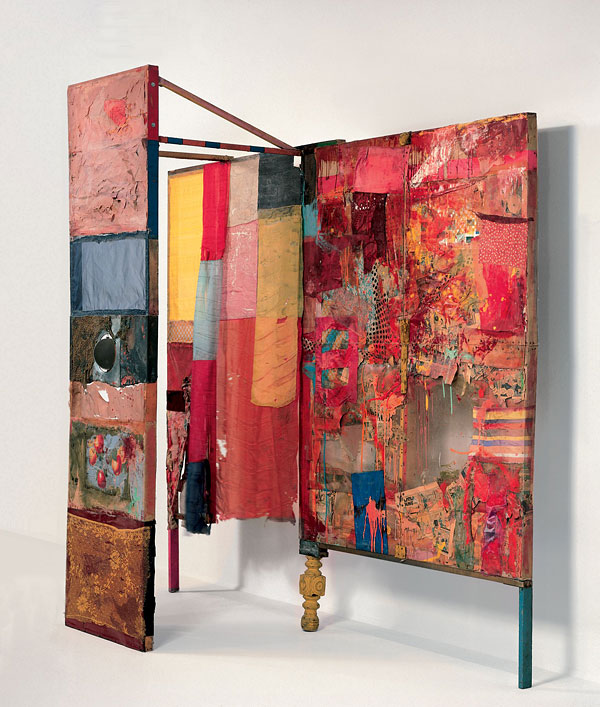
Minutiae, 1954 Freestanding combine Oil, paper, fabric, newspaper, wood, metal, plastic with mirror, on wooden structure, 214.6 x 205.7 x 77.4 cm
From the beginning, the artist has proclaimed: “I want to incorporate into my painting any objects of real life.” (Interview with André Parinaud, op.cit.) Although close in spirit to Dadaism and Schwitters’ use of discarded objects as a creative principle, Rauschenberg distinguishes himself through the dimensions of his works; very large, they invade the viewer’s space. “I would like to make a painting and a situation that leaves as much space for the person looking at it as for the artist.” (ibid.)
Whereas in a Picasso collage, the object or the heterogeneous material is inserted into the framework of the composition, in the Combines, the objects are simultaneously caught in the web that integrates them and are highly recognizable, and as such are rejected. All pictorial illusions and the idea that an artwork has only one meaning are thwarted. “In Rauschenberg’s work, the image depends not on the transformation of an object, but rather on its transfer. Taken from its place in the world, an object is embedded in the surface of a painting. Far from losing its material density in this operation, it asserts, to the contrary and insistently, that the images themselves are a sort of material.” (Rosalind Krauss, “Rauschenberg and the Materialized Image”, in L’originalité de l’avant-garde et autres mythes modernistes [French translation of The Originality of the Avant-garde and Other Modernist Myths (1985)], Macula, 1993). This observation holds for all Rauschenberg’s work, whether it involves an image or an art photo, a shirt or a tyre. Continue reading



 denisestartin.co.uk
