
Robert Rauschenberg, Pledge 1968
Image reproduced from http://takethepicturenow.wordpress.com/2009/07/28/art-history-26/
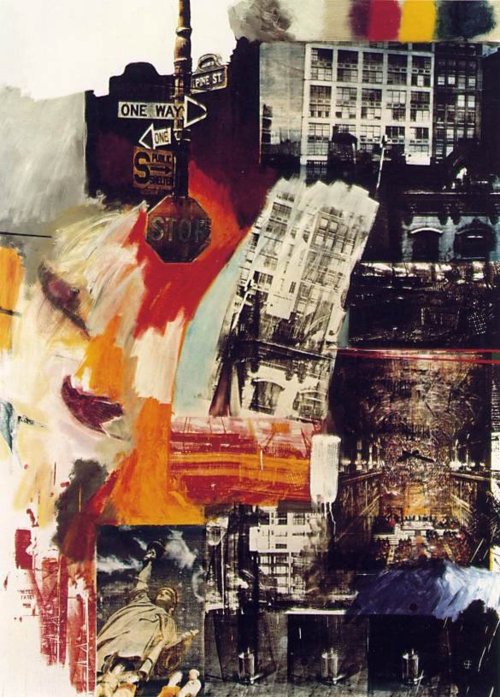 Image reproduced from http://pianoimpro.tumblr.com/post/11688260019/a-piano-improvisation about-robert-rauschenbergs
Robert Rauschenberg, Pledge 1968
Image reproduced from http://takethepicturenow.wordpress.com/2009/07/28/art-history-26/
Image reproduced from http://pianoimpro.tumblr.com/post/11688260019/a-piano-improvisation about-robert-rauschenbergs

R B Kitaj, The defects of its qualities 1967
Image reproduced from http://www.junghans-art.de/art/kitaj/kitaj_1967_k29.html
See also World ruin black magic http://col.lacma.org/mwebcgi/mweb.exe?request=image;hex=AC1999_35_34.jpg
‘…A life as an idiosyncratic repertoire of repetitions; and the account of the life always already ironised by the Freudian knowingness of the narrator. The details of a life, of course, can never be predicted; nor can the content or the exact working of the repetitions [ ]. But what can be assumed is that there will be repetitions, and that these repetitions found their initial and initiating) forms in childhood. …[ ]. Our lives may be turbulent, but it is a patterned, if not actually a structured turbulence.’
Adam Phillips; Childhood Again, Equals, Faber & Faber, London 2002
Text quoted from http://www.judithclarkcostume.com/exhibitions/victoria_albert_01.php

Cy Twombly, Untitled 1970. Oil-based house paint and crayon on canvas. The Museum of Modern Art, New York. Photo: © 2004 Matthew Septimus
It has been said that Cy Twombly’s paintings resemble writing, or are a kind of écriture. Certain critics have seen parallels between his canvases and wall graffiti. This makes sense. In my experience, however, his paintings refer to more than all the walls I pass in cities and gaze at, or the walls on which I too once scrawled names and drew diagrams; his paintings, as I see them, touch upon something fundamental to a writer’s relationship with her or his language. Continue reading
‘instrumental: mechanism and organism share the ideal notion of an empty endless, empty repetition without difference, of an overall functionality and of a rigorous subjection of the parts.’
Raunig G, published by semiotext(e), Los Angeles: 2010 pp.28
 denisestartin.co.uk
