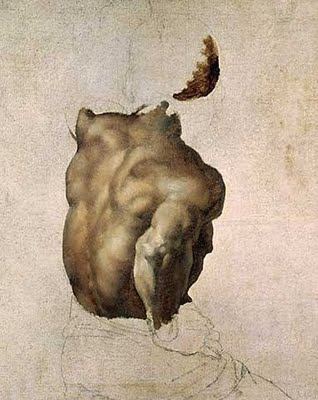
Théodore Géricault’s Study of a Torso for The Raft of the Medusa
‘Mechanism and organism share the ideal notion of an endless, empty repetition without difference, of an overall functionality and a rigorous subjection of the parts.’
Raunig G, A Thousand Machines, semiotext(e), pp.28
“By the end of the eighteenth century a sense of anxiety and crisis began to preoccupy European writers and artists in their relationship to a heroic past. The grandness of that history no longer fit into the framework of the present, and artists felt overwhelmed by the magnitude of past heroic accomplishment.This was soon reflected in artistic representation, from Fuseli on. The partial image, the “crop”, fragmentation, ruin, and mutilation — all expressed grief and nostalgia for the loss of a vanished totality, a utopian wholeness. Often such feelings were expressed in deliberate destructiveness, which became the new way of seeing: the notion of the modern.In The Body in Pieces, the noted critic and art historian Linda Nochlin traces these developments by looking at work produced by artists from Neoclassicism and Romanticism to Impressionism, Post-Impressionism, Surrealism, and beyond.”
 denisestartin.co.uk