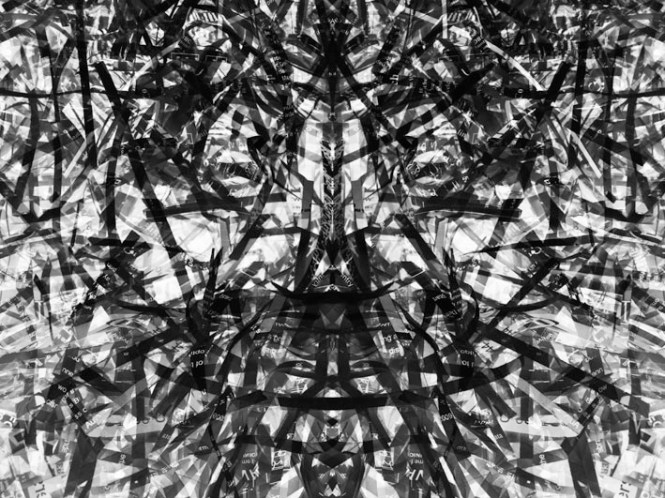
F.E.A.R = False Evidence Appearing Real

Untitled © Denise Startin

Untitled © Denise Startin

“I MUST NOT FEAR. FEAR IS THE MIND KILLER.
FEAR IS THE LITTLE-DEATH THAT BRINGS TOTAL OBLITERATION.

– I WILL FACE MY FEAR.

I WILL PERMIT IT TO PASS OVER AND THROUGH ME.
AND WHEN IT IS GONE I WILL TURN THE INNER EYE TO SEE ITS PATH.
WHERE THE FEAR HAS GONE THERE WILL BE NOTHING.

ONLY I WILL REMAIN.”

FRANK HERBERT – DUNE

The Chamber of Silence

01

Separation

Untitled © Denise Startin

“I can only find myself as far as I regard myself as a diapason-subject, as a living tuning fork that must be held right in front of a loud speaker in order to detect a possible resonance. The world as soul opens itself according to a place: a movement is needed to find the position that renews me. The soul and the world are always one, and always new. (If indeed they are there).

For often there are dead spots

Every sound body has them […] those places on the neck of a guitar that will not resonate to the vibrations of the strings – places where, locally, resonance will be forever extinguished. Similarly there are zones in my body that are irresponsive to the music out there – occasionally this concerns my whole body. Outside of resonance my body is a mere object, a mass, a cadaver. It is world-less, place-less, and merely an object in homogenous space. A thing among things, it is then like a heart that has stopped bleeding, a resonance that has been extinguished, an interval that has imploded, or a syncope that has left it’s orbit…”

Cont’d: An absent presence the body (anaesthetized) and the subject (evacuated) are trave[ai]lling on a continuum from the ecstatic to the forensic subject, a euphoric memory fettered, crippled, occasioned by the touch of death.

Quoted text reproduced from Lyrical Bodies: Music and the Extension of the Soul by Sander van Maas, quoted in Chrono-Topologies: Hybrid Spatialities and Multiple Temporalities, Ed. Leslie Kavanaugh, 2010, p.160.
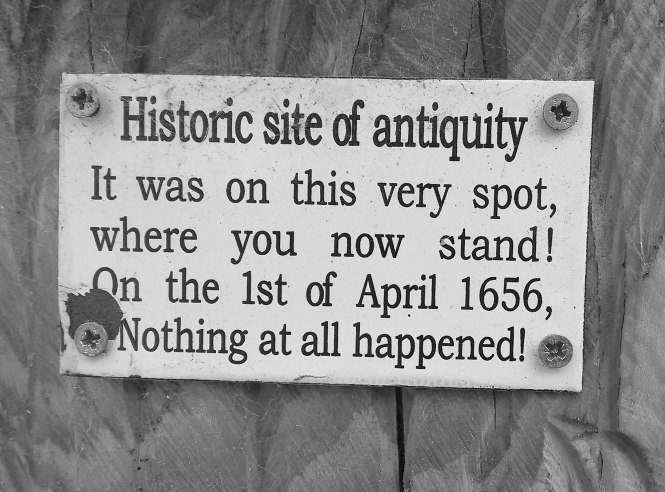
The Occasion of poetry/Poetry of the occasion

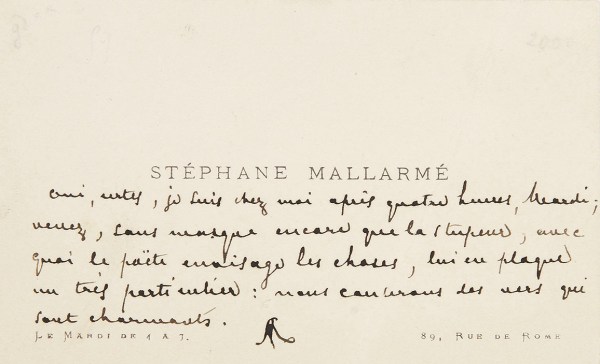
Stéphane Mallarmé 1842–1898, Carte de Visite

Stéphane Mallarmé
1842–1898, Carte de Visite

“In historiography the prosaic element [lies] especially in the fact that…its actual form ha[s] to appear accompanied in many ways by relative circumstances, clustered with accidents, and sullied by arbitrariness, although the historian ha[s] no right to transform this form of reality which [is] precisely in conformity with what immediately and actually happened. The task of this transformation is one in which poetry is chiefly called if in its material it treads on the ground of historical description. In this case it has to search out the inmost kernel and meaning of an event, an action, a national character, a prominent historical individual, but it has to strip away the accidents that play their part around them, and the indifferent accessories of what happened, the purely relative circumstances and traits of character, and put in their place things through which the inner substance of the thing at issue can clearly shine.” – Hegel, Aesthetics.

Text reproduced from The Poetics of the Occasion: Mallarmé and the Poetry of Circumstance, Sugano, M.Z. Stanford University Press: California 1992, pp.1 Image reproduced from http://www.bibliorare.com/products/stephane-mallarme-1842-1898-l-a-s-sm-a-un-poete-5-lignes-sur-sa-carte-de-visite-a-ses-nom-et-adresse-89-rue-de-rome-trace-de-pli-il-sera-chez-lui-mardi-apres-4-heures/