“Following the opening strategy on Cixous’s part in Three Steps on the Ladder of Writing and its accompanying, secret avowal of the autobiogrammy, there takes place what seems the opening onto admission, confession once more, of love, for writers, and, from this, to the confessions of “autobiography”, starting with childhood, Except, we must note, that the childhood, though singular is shared; it is a writing that reiterates the gesture of the loved ones – a gesture at once singular and shared by analogy with the Derrida of the “Circumfession”, in his autobiogrammatical response to St.Augustine. Cixous (re)turns to writers who begin (with writing, with living) as the inaugural gambit, so that autobiography finds itself haunted by autobiogrammy. Continue reading
Citational Fragments
Jaques Derrida
Jacques Derrida once put the question: ‘What if we were to approach…the area of a relationship to the other where the code of sexual marks would no longer be discriminating? [Choreographies, 76] I would like to end with his response, which, like may utopian utterances, is at once sibylline and suggestive:
The relationship [to the other] would not be a-sexual, far from it, but would be sexual otherwise: beyond the binary difference that governs the decorum of all codes, beyond the opposition feminine/masculine, beyond homosexuality and heterosexuality which come to the same thing. As I dream of saving the chance this question offers, I would like to believe in the multiplicity of sexually marked voices. I would like to believe in the masses, this interminable number of blended voices, this mobile of non-identified sexual marks whose choreography can carry, divide, multiply the body of each ‘individual, whether he be classified as ‘man’ or ‘woman’ according to the criteria of usage.
Text reproduced from T Moi, Sexual Textual Politics, 1985:pp173
Image reproduced from http://www.pyke-eye.com/view/phil_I_12.html
André Breton
“…, I have wanted to see some very special object constructed in response to some poetic fantasy. This object in its matter, in its form, I more or less predicted. Now I have chanced to discover it, unique, doubtless, among so many other fabricated objects. It was obviously this one, it always differed in every way from what I had foreseen. You might have said that in its extreme simplicity, which did not keep it from answering the most complicated needs of the problem, it put the elementary predictions of my character to shame[…]. In any case, what is delightful here is the dissimilarity itself which exists between the object wished for and the object found.”
Text reproduced from André Breton, Mad Love (L’Amour fou), 1987:pp:13
Image Breton by Man Ray c.1930 reproduced from http://briancarnold.wordpress.com/
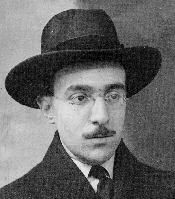
Fernando Pessoa
‘Everything that surrounds us becomes part of us, it seeps into us with every experience of the flesh and of life and, like the web of the great spider, binds us subtly to what is near, ensnares us in a fragile cradle of slow death, where we lie rocking in the wind. Everything in us and we are everything, but what is the point if everything is nothing? A ray of sun, a cloud whose own sudden shadow warns us of its coming, a breeze getting up, the silence that follows when it drops, certain faces, some voices, the easy smiles, as they talk, and then the night into which emerge, meaningless, the broken hieroglyphs of the stars.’
Fernando Pessoa, The Book of Disquiet, 2010:pp11
Image reproduced from http://portugal.poetryinternationalweb.org/piw_cms/cms/cms_module/index.php?obj_id=7051
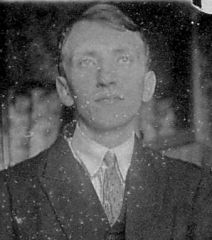
Maurice Blanchot
‘A word may give me its meaning, but first it suppresses it. For me to be able to say,
‘This woman’ I must somehow take her flesh and blood reality away from her,
cause her to be absent, annihilate her. The word gives me the being, but it gives it
to me deprived of being. The word is the absence of that being, its nothingness,
what is left of it when it has lost being – the very fact that it does not exist.”
Blanchot, The Gaze of the Orpheus: pp41-42
Text reproduced from pdf of Rachel Louis Clapham’s Study Room Guide in In (W)reading Performance Writing, Image reproduced from http://www.mauriceblanchot.net/blog/