“The important thing is never to let oneself be guided by the opinion of one’s contemporaries; to continue steadfastly on one’s way without letting oneself be either defeated by failure or diverted by applause.” Gustav Mahler

“The important thing is never to let oneself be guided by the opinion of one’s contemporaries; to continue steadfastly on one’s way without letting oneself be either defeated by failure or diverted by applause.” Gustav Mahler


Coronia © Denise Startin
“VI A few examples: A sailor of antiquity in his boat, enjoying himself and appreciating the comfortable creations. Ancient art represents the subject accordingly. And now: the experiences of modern man, walking across the deck of a steamer: 1. his own movement, 2. the movement of the ship which could be in the opposite direction, 3. the direction and speed of the current, 4. the rotation of the earth, 5. Its orbit, and 6. The orbits of the stars and the satellites around it.
The result: an organization of movements within the cosmos centred on the man on the steamer.”
Extract from Paul Klee “Creative Credo 1920” quoted in Theories of Modern Art: A Source Book by Artists and Critics, Herschel Browning Chip, Peter Howard Selz, pp.186

chiasmus
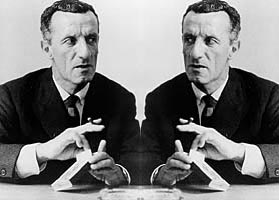
“[T]here must be, then, corresponding to the open unity of the world, an open and indefinite unity of subjectivity. Like the world’s unity, that of the I is invoked rather than experienced each time I perform an act of perception, each time I reach a self-evident truth, and the universal I is the background against which these effulgent forms stand out: it is through one present thought that I achieve the unity of all my thoughts…The primary truth is indeed ‘I think’, but only provided that we understand thereby ‘I belong to myself’ while belonging to the world.”
Text reproduced from Maurice Merleau-Ponty, The Phenomenology of Perception, quoted in Place and Experience, A Philosophical Topography, J Malpas, Cambridge University Press, 1999:pp.72. Image reproduced from http://merleau.jp/whatsE.html

Artist
Art, n. This word has no definition. Its origin is related as follows by the ingenious Father Gassalasca Jape, SJ.
One day a wag – what would the wretch be at? –
Shifted a letter of the cipher RAT,
And said it was a gods name! Straight arose
Fantastic priests and postulants (with shows,
And mysteries, and mummeries, and hymns,
And disputations dire that lamed their limbs)
To serve his temple and maintain the fires,
Expound the law, manipulate the wires.
Amazed, the populace the rites attend,
Believe whate’er they cannot comprehend,
And, inly edified to learn that two
Half-hairs joined so and so (as Art can do)
Have sweeter values and a grace more fit
Than Nature’s hairs that never have been split,
Bring cates and wines for sacrificial feasts,
And sell their garments to support the priests.
Text quoted from The Devil’s Dictionary by Ambrose Bierce, The Folio Society, London, 2003:pp15. Image reproduced from http://www.authorama.com/the-devils-dictionary-2.html [accessed 19072016}