Mapping the Itinerary 2014

Caspar David Freidrich, The Wandered above a Sea of Fog, c.1818

Caspar David Freidrich, The Wanderer above a Sea of Fog, c.1818

“Resolve to perform what you ought and perform without fail what you resolve.”

Benjamin Franklin

Hello Every Bodies and welcome to the New Year here at F=R=A=G=M=E=N=T=S.

Since I have now acclimatised to my new surroundings and the concept or being post-institution, at least as far as my art education is concerned, it is my intention that this year be highly strategic. Thanks to the public institution of the Royal College of Art this private institution, active membership of one, has a strong constitution that accepts responsibility for populating its own flaura and fauna. Like any Visual Arts MA graduate at present there are a number of complex negotiations to undergo, not least the issue of my re-location. Sans RCA these also include practical issues of space, facilitation of practice, technical support, production facilities, critical input and peer support to name a few since one has effectively been decentralised, and you might argue ostracised since I am now no longer in the centre [London] but at the periphery [Regional].

I will of course be continuing with Feminism, Gender and Sexuality in Literature and will post regular updates on critical writing. I will also be following a particular strand from my MA Thesis on Eco-Poetics. Working between these two poles the aim is to outline a territory for practice whereby these routes will eventually converge. I am currently undertaking research for the preparation of a PhD application (the seeds of which were sown in said Thesis). Working with and against these two routes the aim is to construct a path of one’s own through phenomenology, feminist theory, geography, poetics and continental philosophy. Ingesting new intellectual fodder excavates the latent in practice enabling the turning over of new ground to reach a new practical and theoretical horizon. I hope, partially at least, to represent this journey here and of course your company is most welcome.

Yours deep in the thicket that is the Bibliography ,

Dmonogram1


Metamorphosis of the Feminine – The Bloody Chamber, Angela Carter and Paula Rego

Image by Paul Rego

Image by Paul Rego

Drawing on the violence of her Portugese background and it’s folklore Rego’s world conjures up allegorical tales of the physical and psychological violation and repression of feminine experience through often surreal, psychologically, metaphorically and symbolically charged imagery. In these claustrophobic settings and often domestic interiors these female figures, cut off and contained by the frame of the image, often dominate the scene.

Rego’s Women have powerfully robust physiques and the characters in her paintings, drawings and prints are often portrayed in uncompromising and contorted positions including bending, kneeling, lying, squatting, cavorting, undressing. The abject appears in the form of urinating and defecating. Like Smith the female and the bestial are often interchangeable. There is something of the carnivalesque and the grotesque about Rego’s characters, the dancers that appear regularly in her work draw as much on James Ensor as they might on Degas. Rego has also made controversial work about female genital mutilation and abortion. Continue reading

Metamorphosis of the Feminine – The Bloody Chamber, Angela Carter and Kiki Smith

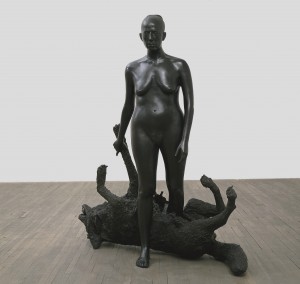
Kiki Smith, Rapture, 2001, Bronze, 67 1/4 x 62 x 26 1/2 inches Edition of 3

Kiki Smith, Rapture, 2001, Bronze, 67 1/4 x 62 x 26 1/2 inches
Edition of 3

“It’s a resurrection/birth story; ‘Little Red Riding Hood’ is a kind of resurrection/birth myth.”

The Bloody Chamber by Angela Carter is a collection of short stories in which Carter re-appropriates the fairy tale in the service of the feminine to re-work patriarchal constructions of gender from within the genre. Female protagonists constantly transgress the boundaries of the patriarchal and the received definition of the fairy tale moral in relation to the feminine (i.e the innocent female child and the sacrificial female). The primary story after which the collection is named is a re-working of Bluebeard by Charles Perrault and was influenced by Carter’s readings of the Marquis De Sade. Carter asserts that Sade “put pornography in the service of women, or, perhaps, allowed it to be invaded by an ideology not inimical to women …” [1]. This extremely brief presentation aims to highlights connections between the representation of female experience in Visual Art and The Bloody Chamber. Continue reading

The view from Nowhere: Dislocated, re-located, discombobulated

[sic] amore

[sic] amore (© Gammie)

Hello Every Bodies

Since I am now post MA, RCA life I have to confess the life element of this statement is sorely lacking due to the fact that I have re-located (to a house on the top of a hill in the middle of nowhere that feels positively rural after living in London for 3 years). I am simply left dangling post MA, RCA……Rather disconcertingly I can actually hear myself thinking, this re-location may be good for the soul but it may also be that I am slowly committing creative suicide. Anyway to take hold of one’s dislocation, discombobulation and direct one’s dangle I am exploring those areas of my practice that somehow never saw the light of day on the MA in practice but were fully present in the thesis (Barthes, Cixous, Kristeva, Irigaray et al). I am undertaking a Social Studies Certificate in Feminism, Gender and Sexuality in Literature and the study of women’s writing and how it has engaged with, and continues to transform and challenge the politics of gender, sex, and sexuality. Continue reading

The Victorian Tactile Imagination, Birkbeck 19-20th July 2013

tumblr_mhycwzaAkp1qjehcpo1_500

“This conference will explore the various ways in which the Victorians conceptualised, represented, experienced, performed and problematized touch. What does touch signal in nineteenth-century art and literature, and how is it variously coded? How are hands and skin – tactile appendages and surfaces – imagined in the period? By investigating the Victorian imaginary of touch, the conference will address and reappraise some of the key concepts and debates which have shaped Victorian studies in the past twenty years – in particular the emphasis on visuality as the dominant mode via which subjectivities and power were effected in the period: not least Jonathan Crary’s influential thesis that the nineteenth century witnessed a pervasive ‘separation of the senses’. The conference aims to investigate instead the workings of a more textured vision and reanimate the interoperability of sight and touch in nineteenth century culture.

The conference will also extend and build upon recent critical studies that have begun to explore nineteenth-century tactility in relation to material culture, bodies, and the emotions. By focusing closely on touch and tactility, it aims to establish whether and in what terms we might talk about a Victorian ‘aesthetics of touch’, and to explore how touch constructs and disrupts, for example, class and gender identities. It will also consider the historical trajectories of touch, asking, for example, in what ways does touch mark or blur the divide between Victorianism and Modernism?”

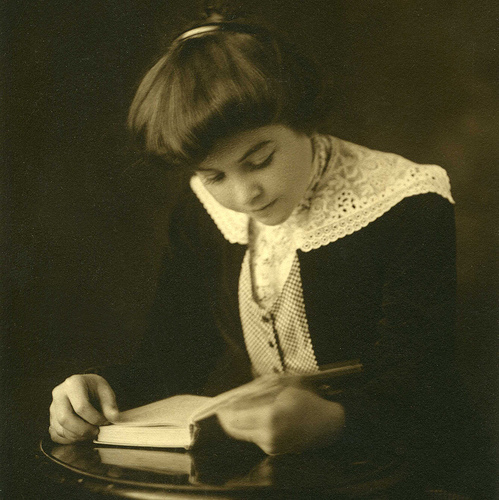
Text reproduced from http://www.bbk.ac.uk/english/our-research/research_cncs/our-events/the-victorian-tactile-imagination. Image reproduced from http://www.tumblr.com/tagged/victorian%20women