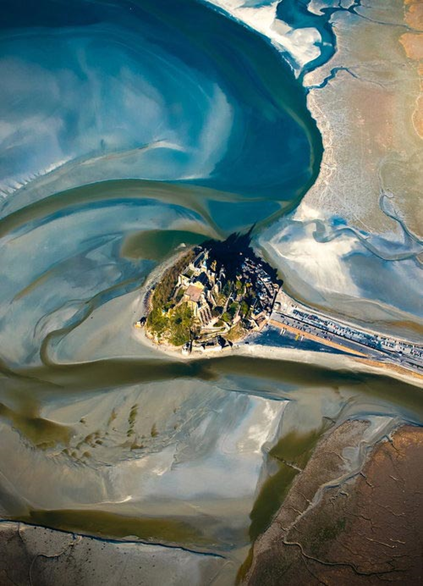
“The faery solitude of the place…his castle that lay on the very bosom of the sea…. at home neither on land or water, a mysterious amphibious place, contravening the materiality of both earth and waves…That lovely, sad, sea-siren of a place!.” The Bloody Chamber, p.8-9
This very brief analysis explores how we can approach gendered relations from the perspective of location to reveal the symbolic and metaphorical significance of Mont. Saint- Michel as it is employed in Angela Carter’s The Bloody Chamber. This analysis was given recently in a very short presentation. Examining Mont. Saint- Michel I explore its potential to represent feminine and masculine principles, nature and culture and how it is central to relations between the bride, her mother and the Marquis. Working through visual and sonic imagery highlights the relations between female anatomy, biology and the cyclical feminine flow ontology of the ‘sea-girt’. My interest lay specifically in the concept of the sea-girt, as a border or boundary surrounded or enclosed by the sea and how we might consider this in relation to the porous and the feminine. Continue reading →
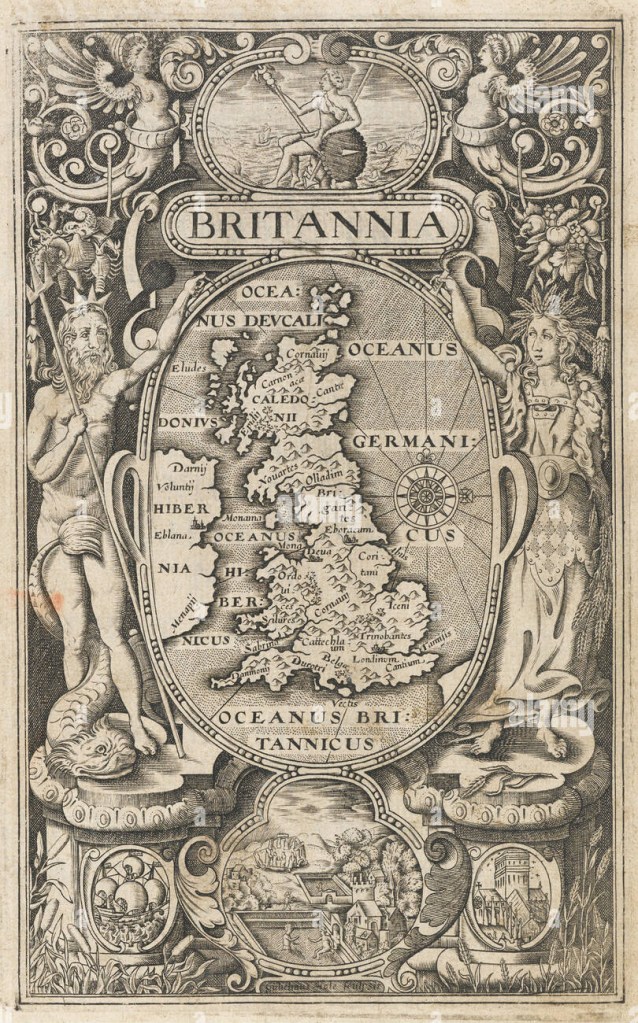
“A map of England, Wales, Scotland eastern Ireland, in an oval supported by Neptune and Ceres, with vignettes of Britannia sitting on a rock, a ship, St Paul’s Cathedral, and Stonehenge and the Roman Baths. On the map London and York are marked, but most of the other names are tribes. This frontispiece was one of three maps engraved by William Rogers (c.1545-c.1604) for the 1600 edition of William Camden’s ‘Britannia’, the fifth edition of the work, yet the first to contain maps. It was not until 1607 that a full suite of county maps was included, alongside a larger version of this map, engraved by William Hole.”
Chorography designates “a regional map in Renaissance geographic texts and the artistic description of regions” viewed and experienced from within linking “regional events at the time of occurrence in pictorial representations.” (Olwig 2001 and Curry 2005 cited in Päivi Kymäläinen and Ari A. Lehtinen 2010: 252). Chorography or place‐writing forms an aspect of the tri‐partite structure belonging to a classical Geographic distinction between Topography, Chorography and Geography, Päivi kymäläinen and Ari A. Lehtinen (2010). Chorography, defined by the polymath Ptolemy in the Geographike Hyphegesis (c.149AD) takes region as its lens. This field-based approach and detailed descriptor of place qualitatively maps characteristics of the locale by examining the constituent parts of that place “to describe the smallest details of places.” Morra J, Smith M (2006: 17-18). Cormack states “Chorography was the most wide ranging of the geographical subdisciplines, since it included an interest in genealogy, chronology, and antiquities, as well as local history and topography…unit[ing] an anecdotal interest in local families and […] genealogical and chronological research.” (Cormack 1991 cited in Rohl 2011: 22).
Chorography was re-discovered in Renaissance Geography and British Antiquarianism 16th -17th centuries. Historically William Camden’s Brittania (1586) or a Chorographicall Description of the most flourishing Kingdomes, England, Scotland, and Ireland is an encyclopaedic approach to a geographic, historical topographical survey of the British Isles which has been identified as a classic exemplar of the renaissance of a chorographic work “connecting past and present through the medium of space, land, region or country.” (Rohl 2011: 22). Camden’s place in this changing historiographical framework of the English Renaissance is critical to elevating the field of historical studies in tandem with scientific documentation as a new and original contribution to knowledge and the discovery of ‘England’ and a sense of ‘Englishness’ (Richardson 2204: 112).
With its overriding pre-occupation with place Camden’s Brittania (1586), arranged chronologically, is a county-by-county survey of England & Wales which travels from the South to the North and represents a new ‘topographical-historical method’ (Mendyk 1986 cited in Rohl 2011: 22). The science of map making was still in it’s infancy but Camden was linked to its development and utilised it when it became available (Richardson 2004:117). Cartographic representations however “aim at synchronic representation”, chorographic descriptions of the countryside, by contrast, opt instead for the diachronic.” Reconstructing a topographically organised historical account in a specific area. Hence in Marchitello’s formulation “Chorography is the typically narrative and only occasionally graphic practice of delineating topography not exclusively as it exists in the present moment, but as it has existed historically. This means not only describing surface features of the land (rivers, forests, etc.), but also the “place” a given locale has held in history, including the languages spoken there, the customs of it’s people, material artefacts the land may hold, and so forth.” Marchitello in (Swann 2001, p.101). British Antiquarianism therefore retrieved chorography and recreated it in an expanded field, re-interpreting its legacy, ensuring its survival, restoration and continuing communication. Susan Stewart discusses the antiquarian as being “moved by a nostalgia of origin and presence” whose “function is to validate the culture of ground.” (1984:153)
Introduction: Analysis of the following articles have revealed problems in defining the field of chorography as well as methods, theories and insights which warrant further examination. These summaries identify, illuminate and reflect on these issues and their implications in theory and practice.
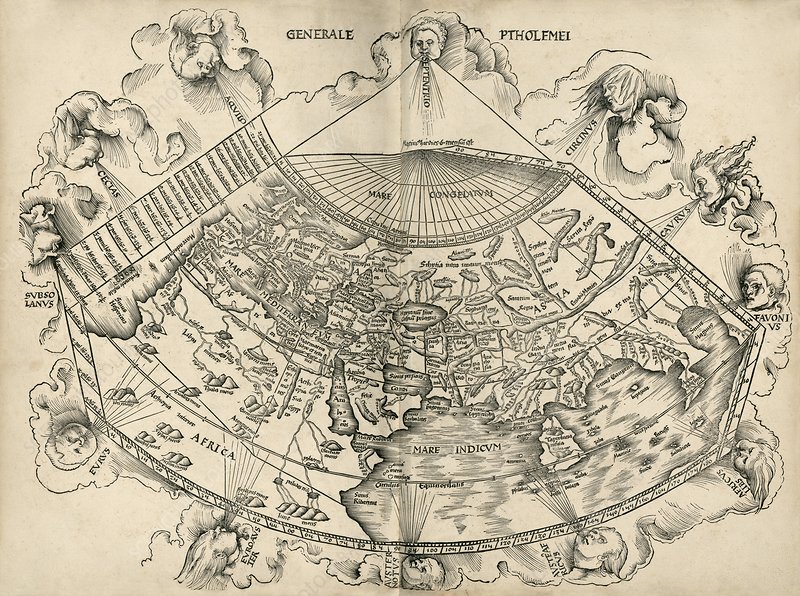
Ptolemy’s world map. This map of the world is from an edition of Ptolemy’s ‘Geographia’, published in 1513 by German cartographer Martin Waldseemuller (c.1470-1520)
Curry’s paper is concerned with the conflation of place and space in contemporary discourse which commonly obfuscate and erase their differences. His primary aim is to elaborate upon the terms chorography, topography and geography and delineate their differences by examining their ‘technologies and practices’. He suggests chorography is limited to the geographer’s knowledge, clearly in the context of this research this is not the case and in his own words ‘it is alive and well.’ Curry argues these geographic ways of knowing each have their own objects of study; region, place and the earth’s surface. He is critical of both their neglect in discussions of place or analyses which focus on scale in relation to these concepts as opposed to form and function. Curry employs a complex analogy of the invention of the US ZIP code to illuminate his argument.
Curry compares and contrasts these terms by tracing and re-interpreting their origins to distinguish them from contemporary understandings. He locates chorography and topography within foundational concepts of place and memory. Chorography was a qualitative way of interpreting the world, both celestial and terrestrial, and this knowledge was located in ‘signs or symbols’ which aimed to perceive relations ‘between events, places and the times of their occurrence’. He relocates topography’s association with mapping by placing it in the oral tradition and the ‘art of memory’. In this context places are created, narrated, performed and re-formed through symbolic associations. Place and experience are coextensive with each other and this element of the mnemonic has already been established independently in prior research.
For Curry the importance of this argument is not simply a matter of different scales of apprehension, but more significantly is intrinsically linked to repositories of knowledge, dissemination and retrieval. He argues space was ‘invented’ against the backdrop of place, due to emergent technologies necessitated by an increase in information, leading to an erasure of the chorographic and topographic by the geographic. Chorography and topography represent human patterns of knowing and belonging in contrast to the panoptic vision of geography. The implications of this observation equate to an erasure of memory practices and a movement from an embodied and emplaced performance of knowledge to its commodification. Places are increasingly mediated by technology and this also applies to the digital records of archaeological fieldwork. For instance when I was introduced to archaeological fieldwork at Erddig, Wales the corresponding planar database managed by the Historic Buildings, Sites and Monuments Record comprises 24 topographic views of each location in the field; a complex palimpsest inconceivable in a single view. This centralization of information which allows for the preservation of heritage data becomes an abstracted space of typology and categorization devoid of the people that inhabited them or the places that created them.
Curry’s analogy of the standardisation of the ZIP code can, in the context of this paper, be equated with geography reaching its empirical, scientific, mathematical and spatial exactitude in the art of cartography. This organisation of geographical knowledge, in the case of the ZIP code, privileges spatial points and co-ordinates whereby the particularities of place, regions, difference, the local and thus topography and chorography are subsumed and erased by spatial systematisation, the realm of demographics and the global organisation of information.
Introduction: Analysis of the following articles have revealed problems in defining the field of chorography as well as methods, theories and insights which warrant further examination. These summaries identify, illuminate and reflect on these issues and their implications in theory and practice.
Paper 3: Rohl, Darrell J. (2012) Chorography: History, Theory and Potential for Archaeological Research. TRAC 2011: Proceedings of the Twenty-First Theoretical Roman Archaeology Conference. pp. 19-32.
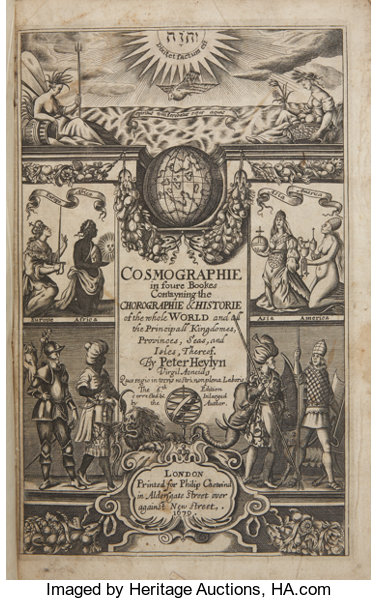
Peter Heylyn. Cosmography in Four Books. Containing the Chorography & History of the whole World
The aim of this paper is a ‘tentative’ attempt at a theoretical framework informed by a close reading of classical texts in relation to contemporary discourse. Rohl states prior translations of Ptolemy’s description of chorography have conflated it with ‘likeness’. Within chorography’s history the term did become synonymous with a regional map gathering “information in the form of pictorial representations” (Kymäläinen and Lehtinen 2010: 252). Although he does not acknowledge this alternate history Rohl states in the 19th–20th centuries chorography gave way to ‘empirical […] topographic and spatial analysis’ which we might understand as cartography in its present sense. According to Rohl this coincided with the sublimation of antiquarianism into the discipline of archaeology. He also notes the resurgence of chorography in historical, literary and archaeological discourse and the study of ‘early modern Britain’.
Rohl’s theoretical chorographic framework is built upon a variety of historic and contemporary sources which in practice would be difficult to quantify. Within this Rohl cites Bossing who places the existentially emplaced literature or geopoetics of Thoreau into the tradition (1999) whose emphasis on chorography as place-writing is a literal translation of the term. Bossing’s quote concerning chorography’s textual ‘advantage over cartography’ appears misplaced since the term cartography is not synonymous with chorography. Again there is an overt emphasis on representation creating a simple binary which appears unproductive. Subordinating the visual to the textual or vice versa indicates on ongoing argument between mimesis and diegesis. However, some antiquarian works and chorographic maps are iconotextual. Rohl’s way out of this aporia is to expand his use of the term representation into ‘multi-media’ (actually employed by McLucas, see below) noting the unproductive limitation of chorography to ‘writing.’ However, this is a rather limited interpretation of the suffix graphy which is a combinatory form denoting a process or form of drawing, writing, representing, recording, describing and therefore is not limited to writing.
In both practices it is worth noting the intersection of region or place, event and temporality. There is a significant corpus on the chorographic map however I maintain the archaeological trajectory for this research will enable an expanded application of chorographic methodology to artistic practice. Rohl discusses these investigations which have been driven by Michael Shanks and his collaborations with Mike Pearson and the late Clifford McLucas, visual theorist. Pearson and McLucas co-founded the Welsh site specific-theatre company Brith Gof (National Library of Wales 2013). “Brith Gof was part of a distinct and European tradition in the contemporary performing arts – visual, physical, amplified, poetic and highly designed. Rather than focusing on the dramatic script, its work is part of an ecology of ideas, aesthetics and practices which foregrounds the location of performance, the physical body of the performer, and relationships with audience and constituency. Brith Gof’s works thus deal with issues such as the nature of place and its relation with identity, and the presence of the past in strategies of cultural resistance and community construction.” [1] Their site specific multi media works dealt with memory, place and belonging.
Pearson and Shanks employed a metaphor for antiquarian approaches; the Deep Map, a term appropriated from Heat-Moon, PrairyErth (a deep map) (1991). This work is a literary cartography of place, an epic tome and a 9 year sojourn across a single Kansas County recording all manner of incidences and is described by Calder as a form of “vertical travel writing” that interweaves “autobiography, archaeology, stories, memories, folklore, traces, reportage, weather, interviews, natural history, science, and intuition”.[2]According to Shanks the deep map ‘attempts to record and represent the grain and patina of place’ (Pearson and Shanks 2001:64). McLucas outlines a ten-point scale of the Deep Map: No.4 states ’they will be genuinely multi-media’ (Jones and Urbanski n.d). Rohl does not discuss McLucas further. This deep map echoes the ‘thick description’ of ethnographic fieldwork which aims to ‘draw large conclusions from small but very densely textured facts.’ (Geertz 1973: 28). Pearson’s own exercise in deep mapping is a complex intertextual topography and autobiographical derivé incorporating region, locale, chorography, landscape, memory, archaeology and performance where historical, social, cultural and environmental temporalities are foregrounded. Landscape is not used here literally in reference to the scene of the action; Lincolnshire but as a symbolic and metaphorical re-imagining, through landscapes past and present.
Rohl more explicitly states the link between Landscape Archaeology and chorography owing to their focus on multi-temporal place relations. He expands on the list of the ten chorographic methods, explaining how they operate in relation to fieldwork, suggesting they are selectively practised according to the object of study. These include 1] “Regional Field Survey: This involves both the experience and the research of the choros and originates from chorography’s theoretical emphases on place and experiece. 2] Inquiry using a variety of sources i.e documents, maps, interviews, digital databases and GIS. 3] Collection of facts, stories and objects. 4] Detailed description and/or measurement – of specific sites, structures, people and objects encountered. 5] Listing of notable features, specific sites, artefacts and historical events. 6] Analysis examination of place names, sites, objects that is broadly representative. 7] Visualisation in the form of vivid textual description, drawings, phots, reconstructions, maps, performance and new media. 8] Historiography – examination and tracing of previous accounts, perspectives and interpretations. 9] Critical Thinking on all evidence collected and personal experiences. 10] Presentation and/or Publication – communication of results to experts or the broader public within and without the bounds of the choros.” pp.28-29 He maintains the importance of chorography in the development of archaeology in Britain. Rohl concludes with his PhD research, a chorographic account of the Antonine Wall in Scotland. He also urges those concerned with the histories and memories of place, landscape, monument and regions to devise and develop chorographic sensibilities.
Introduction: Analysis of the following articles have revealed problems in defining the field of chorography as well as methods, theories and insights which warrant further examination. These summaries identify, illuminate and reflect on these issues and their implications in theory and practice.
Paper 2: Shanks, M. and Witmore, C. (2010) “Echoes across the Past: Chorography and topography in antiquarian engagements with place”. Performance Research 15 (4), 97-106.
William Gell, Study of a lekythos (Notebook 1, GELL 4534b)
The aim of this paper is to elucidate chorographic and topographic methods in various strands of Antiquarian practice. Shanks and Witmore identify common components of Antiquarianism including local and national history, geography, the regional, examination of archaeological remains and the act of collecting. Although chorography is pre-disciplinary they claim a genetic link forms the basis of contemporary disciplinary approaches across heritage management, tourism, archaeology, historical geography and contemporary arts practice. They argue for a genealogical understanding of inter or trans-disciplinary practices concerned with relations of land, place, and locational identity to provide an enhanced understanding of present disciplinary, practical and academic positions. They substantiate these claims by drawing parallels between 16th-19thC Antiquarian practice concerned with “the history and geography of regional landscapes and the management and collection of archaeological artefacts […] seeking tangible historical roots and emerging nation states of modernity” and “contemporary global engagements with land and senses of place” of which they argue Antiquarianism is the main foundation. pp.97
Shanks and Witmore explore three primary components of Antiquarian practice including ‘chorography, itinerary and topography’ in part by way of the Scottish Borders. Their succinct, though unexpanded, definition is etymologically uncomplicated and more closely reflects my own understanding of chorography as ‘the documentation of region’. This practice includes the act of journeying and movement (itinerary) and the intersection of past and present in relation to the landscape (topography). They utilise the concept of performance and the performative to lever open unresolved issues at the heart of antiquarian practice including ‘tensions of property, belonging and ownership, anxieties about scientific and literary authenticity and social responsibility’ which warrants further analysis, pp.97
Through a close reading of Antiquarian texts, the authors perform a comparative analysis of works by William Gell, Martin Leake and the ‘literary antiquarian’ Walter Scott. They contrast their methods, attitudes in practice and also what unites them; a quest for the authentic, the fragment, the quotidian, elevating the historical detail to the status of epic. Although there are crucial distinctions to how this process is performed and manifested the authors draw attention to the implications of representation beyond the idea of medium as a means to an end i.e. the ethics and politics of representation and speaking authentically for others. These concerns are redolent of a distinct strand of Critical Ethnography under consideration for this research.
The lay of the last minstrel – by Sir Walter Scott, Illustrated by James Henry Nixon
Their analysis shows Gell and Leake take a scholarly, rational and distanced stance which is measurable, cartographic, precise, descriptive and forensic in attitude.The implications of placing Scott in the chorographic canon is an emphasis on oratory, the art of memory, folk-lore and the vernacular Ballad. Scott is not simply a collector for the sake of historic facts in and of themselves nor is he concerned with a distanced antiquarian, empirical exactitude of observation and precise recording. Scott’s literary, discursive and interpretative mode becomes an act of re-collection, re-writing, re-telling and re-presenting. Scott performs a curatorial act, a selective re-framing which recuperates, conserves, transforms and embellishes. In the case of The Lay of the Last Minstrel 1805, set in the middle of the 16th century, occupying Three Nights and Three Days, the poem articulates the manners and customs of the English/Scottish borders through the ‘narrator’, an ancient Minstrel. Throughout this process Scott’s voice is ventriloquized and dispersed into the collective voice of the ballad, the polyvocal, polyphonic and polyvalent, a performative co-mingling that results in a complex intertextual topography. Shanks and Witmore argue the topical qualities of Scott’s work place him in the tradition. These topics include “landscape and manners, terrain, tradition, scenario and narrative fragment, names and lists, genealogies and toponymies.” pp. 100 Shanks states these features are central to the antiquarian genre of chorography. Scott’s narrative poems and novels setting tales in the distant and not so distant past did much to foster people’s interest in history. Scott was involved in historical study and gained a reputation as an antiquary and practised amateur archaeology. There is no evidence to suggest however that he equated his work with chorography although he may have been familiar with the term. [1]
These contrasting approaches warrant further investigation regarding their significance to this research. According to the authors Scott’s work exceeds the concept of mimesis as representation due to it’s complex construction and fabrication. Prior research has identified this is an important factor to how alternative mimetic theoretical models might inform the study. My MA Thesis, Ariadne’s Dance Floor, Choragraphy and the Ecstatic Subject, (Distinction) Royal College of Art 2013 sought to restore a connection to the philosophical roots of mimesis and to the feminine and dance. The title was not a playful affectation but a statement of political intent via the deliberate spelling of chorography as choragraphy following the work of geographer Inger Birkeland and Julia Kristeva. According to Perez-Gomez [2008] mimesis was not originally connected to imitation “but the expression of feelings and experience through movement, musical harmonies and rhythms of speech.” [2] This underscores one of my own concerns and the need to make a distinction between the performative, embodied act and its subsequent re-presentation, this perceived gap would clarify chorography as both process and product. My concern is an overt emphasis on chorography as representation; as visual medium as opposed to embodied method. Shanks and Whitmore conclude with the idea that insights into the ‘antiquarian genre of chorography’ could provide sound methodological principles for addressing critical epistemological issues, institutional or otherwise, of conducting research.
[2] Alberto Pérez-Gómez, Built upon Love, Architectural longing after ethics and aesthetics, (Cambridge, MA: Massachusetts Institute of Technology, 2006), p.48.