Critical Fragments
Incommunicado

© Denise Startin
Dear Reader
Many apologies for the lack of continuous activity on the blog of late. Having recently produced a thesis for the MA I am undertaking (the effect of which has been to somewhat ironically kill my voracious writing and reading habits) the process has left me textually satiated, linguistically engorged and physically sick.
The thesis was part performative, part theoretical, part confession, part autobiography (which of course is a fallacy since one can only live one’s life not write it).The philosopher Phillipe Lacoue-Labarthe develops this rhythmic train of thought particularly in relation to autobiography and music; ‘the need to tell, to confess, write oneself.’ [1] Perhaps having partly written myself into textual oblivion through examining my haecceity one has been left comparatively mute. To draw upon an analogy between writing and excrement ‘I’ have been evacuated. ‘I’ write myself, ‘I’ kill myself (after Derrida).
In Footnote 115 of the thesis I discussed the relation of the textual fetish and desire, here I quote myself “Elizabeth Grosz explains there are ‘two conceptions of desire – negative and positive.’ The one that concerns us here in relation to Freud and Lacan is desire as lack, that is ‘a yearning for what is lost, absent, impossible. Desire is posited as an economy of scarcity, where reality itself is missing something (the object whose attainment would yield completion), a linked to the death drive (the struggle for mutual recognition) and annihilation (which the object of desire threatens). Continue reading
Thinking on Paper
 “A radical experiment in design and typography Stéphane Mallarmé’s poem Un Coup De Des (A Throw of the Dice will Never Abolish Chance 1897) privileges form over content or rather form as content , such that blank space, varied typography and the material folds of the book augment and even transform the semantics of the text. As Mallarmé writes in his preface to the first issue of the poem:
“The paper intervenes every time an image on its own, ceases or retires within the page, accepting the succession of the others, and it is not a question unlike the usual state of affairs, of regular sound effects or verses – rather of prismatic subdivisions of the idea, the instant when they appear and during which their cooperation lasts , in some exact mental setting. The text imposes itself in various places, near or far from the latent guiding thread, according to what seems to be the probable sense.”
(For the French version and (albeit different) English translation click here.
Text reproduced from http://directory.eliterature.org/node/573 Image reproduced from http://www.wookmark.com/image/8624/crumpled-white-paper-texture-by-melemel-jpeg-2048-1536
Friedrich Nietzsche

“The assumption of a single subject is perhaps unneccesary: perhaps it is just as permissible to assume a multiplicity of subjects whose interaction and struggle is the basis of our thought and our consciousness in general? A kind of ‘aristocracy of cells’ in which dominion resides? To be sure, an aristocracy of equals, used to ruling jointly and understanding how to command? My hypothesis: The subject as multiplicity. ” (Nietzsche 1968: 270)
For a short but informative passage about Nietzsche and the musical rythms (Also pursued in different ways by Phillip Lacoue-Labarthe and Julia Kristeva) in his texts click here
Text reproduced from Elizabeth Grosz, Volatile Bodies, Toward a Corporeal Feminism, Indiana University Press, 1994: p.122
Image reproduced from http://philossophy.wordpress.com/2010/04/10/modernity/
Word Flesh
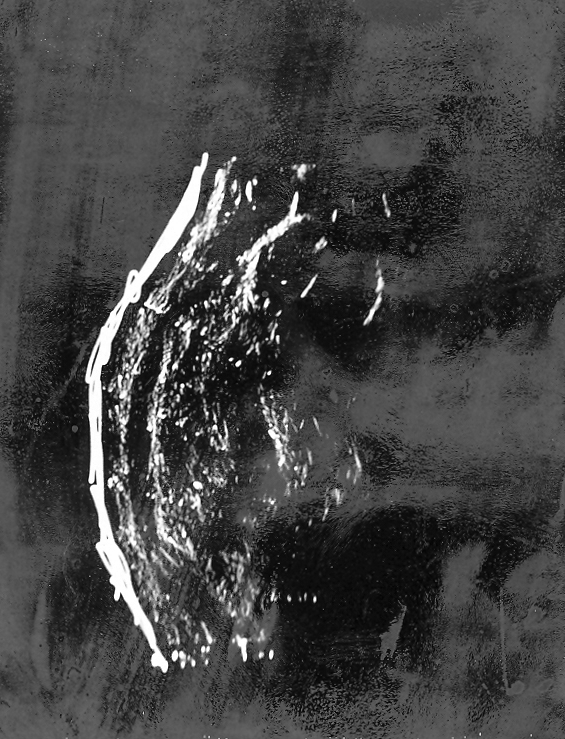
Pre/face © Denise Startin
“FLASH – an instant of time or a timeless dream; atoms swollen beyond measure, atoms of a bond, a vision, a shiver, a still shapeless embryo, unnameable. Photo’s of what is not yet visible and which language necessarily surveys, from a very high altitude elusively. Words always too remote, too abstract to capture the subterranean swarm of seconds, insinuating themselves into unimaginable places.
Writing them down tests an argument, as does love. What is love for a woman, the same thing as writing. Laugh. Impossible. Flash of the unnamable, woven of abstractions to be torn apart. Let a body finally venture out of its shelter, expose itself in meaning beneath a veil of words. WORD FLESH. From one to the other, eternally, fragmented visions, metaphors of the invisible.”

