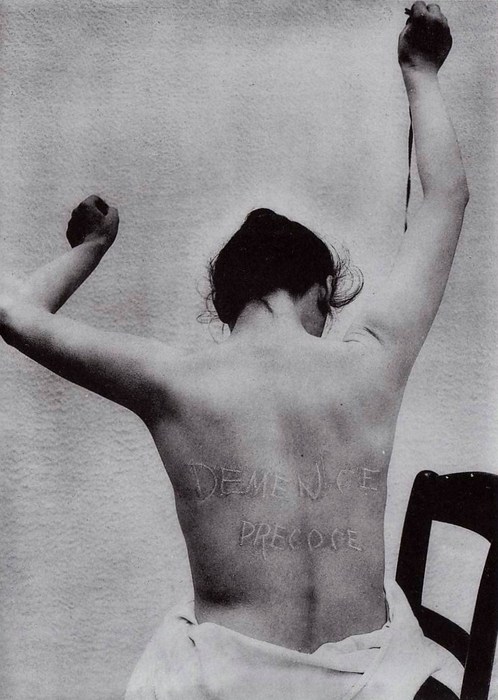
Dermographisme [aka dermographism, dermatographismm or “skin writing] – Démence précoce catatonique, from Nouvelle Iconographie de la Salpêtrière, Paris, 1904.
Dermographisme [aka dermographism, dermatographismm or “skin writing] – Démence précoce catatonique, from Nouvelle Iconographie de la Salpêtrière, Paris, 1904.
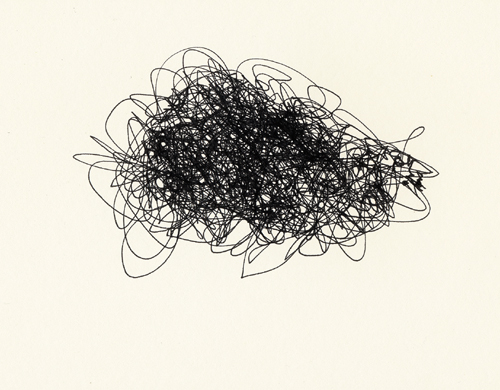
Klee_Line_for_a_walk
“Conspicuously left out of geography’s line – as it is left out of Descartes construction of the ‘I’- is of course the body that writes, and which, in writing, is also being written. Justine Clark explains:
The surface of the drawing is the site of involuntary traces, just as the scene of the body is the scene of involuntary muscular motions – blushing, tics, twitches – the play of internal effects across the surface of the body. If we follow Elizabeth Grosz’s contention that ‘all effects of depth and interiority can be explained in terms of the inscriptions and transformations of the subject’s corporeal surface…that the body can be understood as the very stuff of subjectivity,” then this surface of bruises and blushes, tingles and scars is crucial.”
Carter Paul, Dark Writing, University of Hawaii Press, 2009:pp.82. Image reproduced from http://rodcorp.typepad.com/rodcorp/rodcorps_art/page/2/

Shausaku Arakawa_Out of distance / Out of texture
[Distance of point blank B]
The body is sited. As that which initiates pointing, selecting, electing, determining and considering, it may be said to originate (read co–originate) all sites. Organism-person-environment consists of sites and would-be sites. An organism-person, a sited body, lives as one site that is composed of many sites.”
For more information about the work of the artist Arakawa and Madeline Gins, artist, architect, poet and their architectural poetics in The Mechanism of Meaning please click here
Text reproduced from Architectural Body, Chapter 2 Landing Sites, MadelineGins and Shausaku Arakawa, The University of Alabama Press, USA 2002:pp.5
Image reproduced from http://nga.gov.au/international/Catalogue/Detail.cfm?IRN=74725&ViewID=2&GalID=ALL

Judith Butler
“Performativity” Butler says “is construed of that power of discourse to produced effects through re-iteration, to produce what it declares.” Performativity however, is only possible within the constraints of “iterability.” We are spoken more than we speak, done more than we do; therefore we are “constrained by what remains radically unthinkable” and, in the area of sexuality “by the radical unthinkability of desiring otherwise”. Inhabiting a sexed position then always engages citational practices, “citing the law under and through the force of prohibition and taboo, with the threat of ostracism and even death compelling and controlling the shape of production but without fully pre-determining it.” “Agency” then, according to Butler’s reconfiguration, is always “on drugs”. It is always under the influence of language and can only take place within our reiteration of the reiterable. Continue reading

Hands:Holding by Rune T
‘Foucault uses the language of space to highlight the formative effects of discourse and the instability of the plane it constitutes. Foucault’s analytics and politics are inextricably linked to creating an alternative physics of space. His alternative spatial text-ure both represents itself as a more accurate depiction of the real work of power and shifts the paradigmatic grounds for conceiving power. Power has generally been conceived as a dichotomous structure pairing intent and result, cause and effect, oppressor and oppressed. But Foucault levels the dimensionality of the social edifice, making power, knowledge, and subjects alike the temporary internal effects of a dispersed, evanescent field. The subject loses its organic solidity to appear like a bubble within a perpetually plastic substance. Subjects appear ‘in-different’ neither casually prior to a power’s mechanism, not imaginative outside its perpetually [re]formative web: Continue reading

