Robert Smithson – Strata

Robert Smithson – Strata 1970

“Robert Smithson’s photo-essay “Strata” was published in 1970, the same year Anderson’s recycling symbol was released. 1970 also witnessed the inaugural Earth Day, which consecrated an ecological movement that had been building over the decade. Smithson’s own Earth Art during the 60s and into the 70s was similarly concerned with pollution, land reclamation and ecology, though his interests led him always to contemplate the Earth’s matter on an extremely wide time-scale.

“A book is a paper strata,” Smithson says, stringing snippet-like descriptions of distant times together with mentions of x-rays, stereoscopes and dioramas in museum displays, emphasizing the latter’s near-obsolescence so as to project the reader into the museum’s (and the text’s) entropic future. The canny paratactic construction of “Strata,” telegraphic in style and lacking conjunctions and transitions, links past, present and future through verbal abutments and layerings that connect as much as they disjoin. The point bears repeating, as Smithson’s ecological consciousness emphasizes the mind’s distance from the matter it contemplates, a distance given dynamic form in his dialectic of site and non-site, a conjoining disjunction that both bridges the gap between museum and natural site yet defies synthesis in opening the dialectic onto entropic processes in both space and time.

Sea butterflies fall into a nameless ocean. Plaster restorations collecting dust in the Museum of Natural History. The tracks of trilobites harden into fossils. Accumulations of waste on the sea bottoms. Jelly-fish baking under the sun. Digestive systems shown in diagrams. … A tendency to amorphousness….”

Image and text reproduced from https://johnculbert.wordpress.com/tag/strata-a-photogeographic-fiction/ (accessed 11/11/23)

Utopia – Sir Thomas More

Text by Cristina Acuna and Reagan Bleasdell

“Sir Thomas More was the first person to use the term “utopia,” describing an ideal, imaginary world in his most famous work of fiction. His book describes a complex community on an island, in which people share a common culture and way of life (“16th Century Dreams: Thomas More”). The term he coined derives from the Greek word ou-topos meaning “nowhere,” (“Utopia Summary”). Ironically, it is the opposite of the similar-sounding Greek word eu-topos meaning “a good place,” (“Utopia Summary”). At its heart, the book poses the question of whether there could ever be such a thing as a “perfect” world and served as a platform to highlight the chaos of European politics at the time.”Sir Thomas More was the first person to use the term “utopia,” describing an ideal, imaginary world in his most famous work of fiction.

The book, written in 1516, is More’s attempt to suggest ways to improve European society, using “Utopia” as an example. More was a major figure of the English Renaissance who cared deeply about the moral and political responsibilities of individuals. He eventually rose to one of the highest offices in the land, and, as chancellor of England in 1529, came up against his own king with disastrous consequences. More strongly opposed Henry VIII’s separation from the Catholic Church and refused to sign the Oath of Supremacy, which would give King Henry more power than the Pope. He was convicted of treason and was imprisoned in the Tower of London. They continued to urge him to sign the oath, but he refused. He was sentenced to be hanged, drawn, or quartered, the usual punishment for traitors, but the king commuted this to execution by decapitation. While on the scaffold, he declared that he died, “The king’s good servant, and God’s first” (qtd. in “Thomas Moore” Wikipedia).

The society depicted in Utopia differs from the European society that Thomas More was living in at the time, one rife with intrigue, corruption and mired by scandal. The author’s experience with politics in his time and the Utopia that he invented demonstrates this contrasting relationship: Utopia is communal, allowing its people to easily meet their needs, while European society is described as a place where, “Idle monarchs and nobles seek to increase their own wealth and power at the expense of the people, who are left in poverty and misery” (“Utopia: Theme Analysis”). Clearly dissatisfied with the world he was living in, More sought to create a different place altogether on the page—a world free of the hierarchies that ultimately cost the author his life.”

Text reproduced from https://pressbooks.pub/earlybritishlit/chapter/sir-thomas-more-utopia/ (accessed 25/10/23) Image reproduced from https://www.britannica.com/topic/Utopia-by-More (accessed 25/10/23)

Currently reading

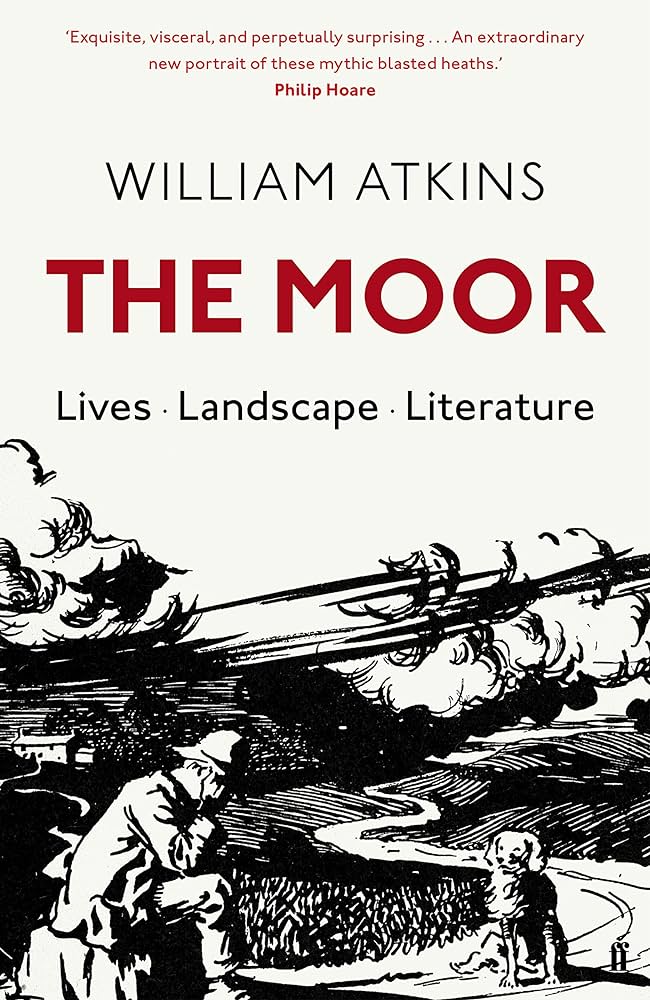
In this journey across England’s most forbidding and mysterious terrain, William Atkins takes the reader from south to north, exploring moorland’s uniquely captivating position in our history, literature and psyche. Atkins’ journey is full of encounters, busy with the voices of the moors, past and present. He shows us that, while the fierce terrains we associate with Wuthering Heights and The Hound of the Baskervilles are very human landscapes, the moors remain daunting and defiant, standing steadfast against the passage of time.

Robinson in Ruins

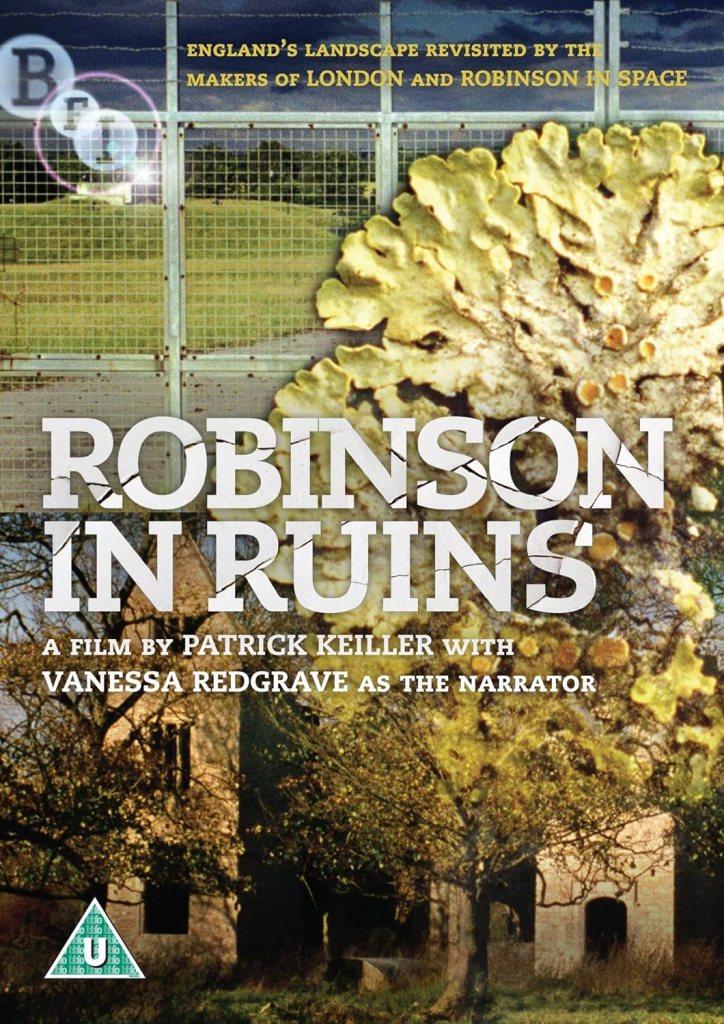
“The opening sentence of Patrick Keiller’s new film, voiced with laconic precision and italic irony by Vanessa Redgrave, is calculated to quicken the hearts of admirers of Keiller’s enigmatic oeuvre: “When a man named Robinson was released from Edgecote open prison, he made his way to the nearest city and looked for somewhere to haunt.” Robinson in Ruins is the third of Keiller’s feature-length essay-fictions to deposit his eccentric protagonist among the relics of millennial England, where he functions once more as the comically half-deluded conduit for the director’s own brand of visionary scholarship. As a fictional invention, the autodidact aesthete Robinson, whom we only ever encounter via the films’ narrators’ vexed relations with him, is an absurd sort of wraith, tricked up from reminders of Defoe and Céline, but surely also a descendant of the Regency showman Robertson, inventor of the proto-cinematic phantasmagoria. In Robinson in Ruins, his spectral patch is the landscape around Keiller’s own home in Oxford: its industrial heritage, its residual romanticism, the weird energies of Englishness at a time of global economic collapse.

In successive close-ups, a patch of lichen on an Oxford road sign comes to resemble the profile of Goethe. Robinson, at large among the relics of military-industrial technology, eventually settles on a disused cement works, crumbling into romantic ruin, as the potential site of a new utopian community. The history of clearances and land riots ghosts the new landscape of PFI follies, unpeopled agribusiness and the amnesiac transformation of every fraught patch of land (Greenham Common included) into a Site of Special Scientific Interest. All of this is rendered, meanwhile, with Keiller’s customarily austere but rapt visual style – though in this case, as suits a film partly about the persistence of pastoral in the face of rapacious land grabs, the shots are longer. The camera tarries with fields of oil seed rape, nodding foxgloves and shivering primroses until they start to look monstrous, every bit as alien as the relics of 19th-century architecture and décor that so exercised the surrealists. Before Keiller’s (or Robinson’s) prophetic gaze, the English countryside is a monument to itself, and ripe for revolutionary appropriation.”

Text reproduced from https://www.theguardian.com/film/2010/nov/20/robinson-ruins-patrick-keiller-dillon (accessed 18/09/23)

The Pilgrims Progress

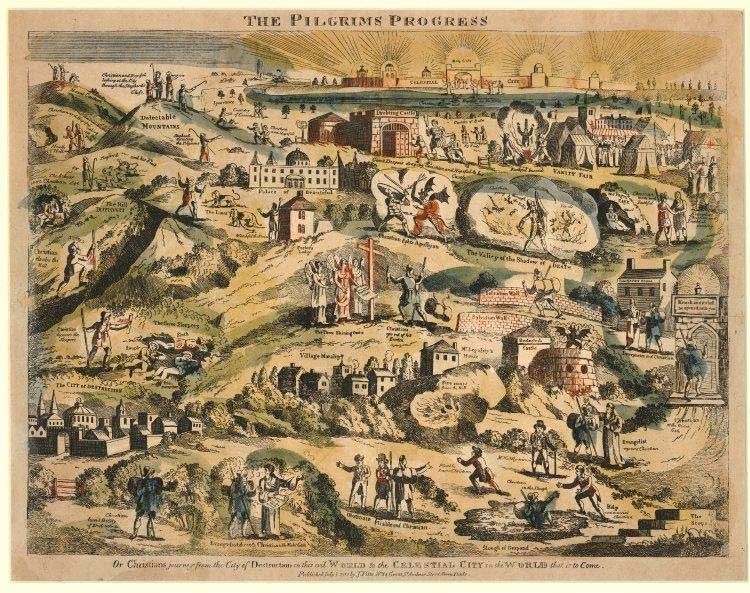
“The Pilgrims Progress, or, Christians Journey from the City of Destruction in This Evil World to the Celestial City in the World That Is to Come” ([London]: Published . . . by J. Pitts, no. 14 Great St. Andrew Street Seven Dials, July 1, 1813). Copperplate map, with added color, 34 × 45 cm, on sheet 41 × 51 cm [Historic Maps Collection].

“This anonymous map visually interprets English preacher John Bunyan’s religious allegory The Pilgrim’s Progress from This World to That Which Is to Come: Delivered Under the Similitude of a Dream, Wherein Is Discovered the Manner of His Setting Out, His Dangerous Journey, and Safe Arrival at the Desired Countrey (1678). (The book was probably written during his imprisonments for preaching without a license.) The protagonist, named Christian, faces temptations and digressions that could prevent him from reaching his goal, God’s celestial city. The symbolic nature of the work lends itself to graphic illustration: the Slough of Despond, the Valley of the Shadow of Death, Vanity Fair—such “obstacles” have become iconic in Western literature. The universal resonance of Bunyan’s work—it has been translated into more than two hundred languages—accounts for its never having been out of print.”

Image reproduced from https://www.biola.edu/blogs/good-book-blog/2019/pilgrim-s-progress-maps (accessed 14/09/23). Text reproduced from https://library.princeton.edu/visual_materials/maps/websites/thematic-maps/theme-maps/literature.html (accessed 14/09/23)