Intermission

ragleyimages

Ragley Hall Gallery and Studios

Dear Readers

Please accept my apologies for the lack of manual dexterity on my blog of late. I can assure you that even if it appears my fingers have been idle my feet have not and although I have been otherwise indisposed there are changes afoot!. Normal service will be resumed shortly but in the meantime I am pleased to announce that I now have a Studio Space at Ragley Hall in the heart of the Warwickshire countryside. Ragley Hall is a working Estate, Stately Home, Gardens, Butchery and Saw Mill open to the public at the weekends. I will be taking part in the Warwickshire Open Studios Event June 28th 2014.

“Harris Visual Arts was established by Dawn Harris and is based in Ragley Gallery and Studios at Ragley Hall. Operating as a community for artists to develop their practices their aim is to provide affordable artist and gallery spaces to graduates, early career and established artists from the surrounding communities. Currently there are few viable options available to graduating students and artists wishing to develop their practice within this area. Often ignored in terms of producing artistic talent, the West Midlands represents a particular challenge both in terms of the commercial arts scene and artists who wish to sustain their practices in this region after graduating. Harris Visual Arts at Ragley Hall is pushing forward to develop an arts market and keep artists in the region. The unique position of the Gallery and Studio, in a site with an audience interested in heritage and culture, will benefit emerging artists by highlighting quality emerging talent and offering a crucial bridge between training and a professional career. This is a positive step; as London continues to draw in talent from across the UK (and the world) developing off–centre scenes offers an alternative view and a chance for artists to shape their own community.

Many arts organisations work in partnership with a variety of host venues, whether locally loved destinations, tourism, heritage sites or historic gardens with an established visitor base. This encourages audience participation,  creates new audiences and cross-fertilisation between the contemporary arts and heritage sectors. All of which we aim to achieve but critically different is the provision of a permanent gallery and studio’s within an established site where a sense of place and reputation can contribute to the growth and development of the Arts. This will also provide opportunities for education and outreach programmes at the heart of our activity encouraging participation, discussion and reflection about contemporary art.”

Quoted text paraphrased/Images reproduced from http://dawnlharris.wordpress.com/about-gallery-and-studios/
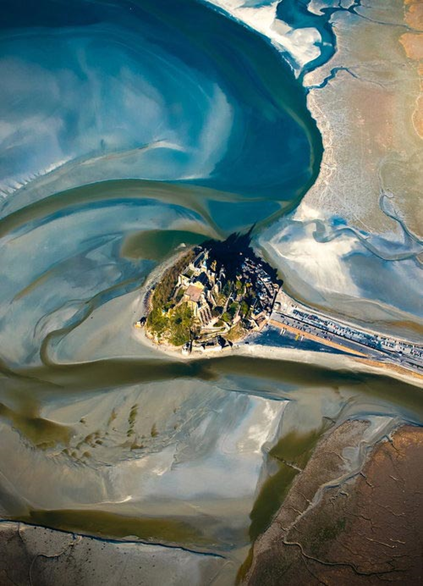
The Gender of Place: Angela Carter, The Bloody Chamber

“The faery solitude of the place…his castle that lay on the very bosom of the sea…. evanescent departures of the ocean, cut off by the tide from land for half a day…at home neither on land or water, a mysterious amphibious place, contravening the materiality of both earth and waves…That lovely, sad, sea-siren of a place!." The Blood Chamber, p.8-9

“The faery solitude of the place…his castle that lay on the very bosom of the sea…. at home neither on land or water, a mysterious amphibious place, contravening the materiality of both earth and waves…That lovely, sad, sea-siren of a place!.” The Bloody Chamber, p.8-9

This very brief analysis explores how we can approach gendered relations from the perspective of location to reveal the symbolic and metaphorical significance of Mont. Saint- Michel as it is employed in Angela Carter’s The Bloody Chamber. This analysis was given recently in a very short presentation. Examining Mont. Saint- Michel I explore its potential to represent feminine and masculine principles, nature and culture and how it is central to relations between the bride, her mother and the Marquis. Working through visual and sonic imagery highlights the relations between female anatomy, biology and the cyclical feminine flow ontology of the ‘sea-girt’. My interest lay specifically in the concept of the sea-girt, as a border or boundary surrounded or enclosed by the sea and how we might consider this in relation to the porous and the feminine. Continue reading

Metamorphosis of the Feminine – The Bloody Chamber by Angela Carter

Georges Méliès, Bluebeard, 1901.

Georges Méliès, Bluebeard, 1901.

The following essay performs a close textual reading of two extracts from Angela Carter’s, The Bloody Chamber. Given the constraints of the assignment [1,000 words] this is a rather crude analysis which, unable to unpack its implications, leads in some respects to the generic and the obvious. In spite of these concerns I have nevertheless aimed for perceptual depth. Since the two passages are analogous I have privileged the former while drawing upon the latter. Rather than litter the post with copious footnotes you can read the Angela Carter Extracts here.I have given the page numbers for reference.

“His wedding gift, clasped round my throat. A choker of rubies, two inches wide, like an extraordinarily precious slit throat.” [p.6]

Carter’s employment of language here is extremely precise. The idea of clasping, of holding fast suggests power and possession (to have and to hold until death do us part?), as if the Marquis’ hands are literally round her throat. If we read this metaphor as asphyxiation, of becoming unable to breathe, and the ‘choker’ as a restriction of the body, particularly the neck (an erogenous zone) and vocal cords this would also increase the awareness of one’s own body as an object. His apparent gift is not just a symbol of wealth but a contractual exchange to which the female protagonist is committed by receiving and wearing it. At this point the choker metaphorically pre-figures the female protagonists fate in the final act and what appears to be her inevitable decapitation.

Continue reading

Metamorphosis of the Feminine – The Bloody Chamber, Angela Carter and Paula Rego

Image by Paul Rego

Image by Paul Rego

Drawing on the violence of her Portugese background and it’s folklore Rego’s world conjures up allegorical tales of the physical and psychological violation and repression of feminine experience through often surreal, psychologically, metaphorically and symbolically charged imagery. In these claustrophobic settings and often domestic interiors these female figures, cut off and contained by the frame of the image, often dominate the scene.

Rego’s Women have powerfully robust physiques and the characters in her paintings, drawings and prints are often portrayed in uncompromising and contorted positions including bending, kneeling, lying, squatting, cavorting, undressing. The abject appears in the form of urinating and defecating. Like Smith the female and the bestial are often interchangeable. There is something of the carnivalesque and the grotesque about Rego’s characters, the dancers that appear regularly in her work draw as much on James Ensor as they might on Degas. Rego has also made controversial work about female genital mutilation and abortion. Continue reading

Metamorphosis of the Feminine – The Bloody Chamber, Angela Carter and Kiki Smith

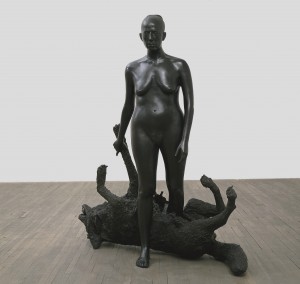
Kiki Smith, Rapture, 2001, Bronze, 67 1/4 x 62 x 26 1/2 inches Edition of 3

Kiki Smith, Rapture, 2001, Bronze, 67 1/4 x 62 x 26 1/2 inches
Edition of 3

“It’s a resurrection/birth story; ‘Little Red Riding Hood’ is a kind of resurrection/birth myth.”

The Bloody Chamber by Angela Carter is a collection of short stories in which Carter re-appropriates the fairy tale in the service of the feminine to re-work patriarchal constructions of gender from within the genre. Female protagonists constantly transgress the boundaries of the patriarchal and the received definition of the fairy tale moral in relation to the feminine (i.e the innocent female child and the sacrificial female). The primary story after which the collection is named is a re-working of Bluebeard by Charles Perrault and was influenced by Carter’s readings of the Marquis De Sade. Carter asserts that Sade “put pornography in the service of women, or, perhaps, allowed it to be invaded by an ideology not inimical to women …” [1]. This extremely brief presentation aims to highlights connections between the representation of female experience in Visual Art and The Bloody Chamber. Continue reading