…it clings…

denise_grant 005b

Ob[l]ituary 2013 – 31st July 2017 (it’s not an end but it has to end)

“If you asked me now who I am, the only answer I could give with any certainty would be my name. For the rest: my loves, my hates, down even to my deepest desires, I can no longer say these emotions are my own, or stolen from those I once so desperately wished to be.” – Evelyn Waugh, Brideshead Revisited

you would not be there to witness the gift bestowed upon me…yet… Albert’s Hall was thronging, hundreds of feet were pounding and my partner punctuated the air…yet…that moment in the spotlight was silent and empty like your grave…

and in that breath I swallowed your death…

…and you cling…

 …yet…there would be no warm embrace, no look of confusion, elation, swelling pride, bewildered furrows, eyebrows acting in amazement, the joy of light and tears in your eyes, on your cheek, no nervous energy coursing round your bodies, no celebratory gustatory delights, no fire to alight your memory
…and you cling…

without speech, in silent voice, telling me how proud you were, how happy you were, whilst the worry lay buried, you would not, could not, speak to me about the future or how you would not, could not, support me

…and you cling…

you would never know I was there, that for one small significant moment the ‘kid’ did good, beyond your wildest dreams, beyond her wildest dreams, yet she would continue to bear this lack, lick this porous festering wound for the rest of her life in utter silence…open wounds are susceptible to infection…in the mud decrepit dangers lurk…

…and you cling…there is no vocabulary to hush this conflict…detached poems speak voices of the dead

….and you cling…and her fury renders her speechless

…and it clings…a stain on the tip of her tongue…a ghost building, silhouettes of words [where] a certain set of gestures are housed

…and it stings

like any clandestine affair my glasses aren’t rose tinted, they are cracked, splintered, broken, smothered in the dirt of you, black excretions of filth exuding through the cracks, the grime of you inhabits […] the stench of you burns […]

in my nostrils, rolls around like grit in my eyes, feels like ash in my mouth; I roll your name around lovingly on my tongue, caressing you

..and it clings…

i roll you around in my mouth and you grate, setting my teeth on the edge. The grime of you inhabits every pore, dirty, filthy little memories secreted away, skin seething like ants

…and you cling…and it stings

no amount of washing can erase your sweet aroma, your putrid stench, your incessant demands, your impenetrability, your indifference, your pushiness, your excess, we sold our souls for you, I had holes in my soles for you, I have holes in my soul for you

...and it stings…and you cling

still you beckoned me with your availability, your parlor games, your desire to cater to every whim, the promise to fulfill any fantasy. Your body gorged my vision, replete with the extent of you, I could never see the end of you, never see beyond you, never get outside you, never get inside you…yet…always the feeling of you moving inside me

…and it stings…and you cling…and it rings

every day over and over, no touch can sooth or break this fever, no difference between aching and waking. What happens if your today keeps exploding? What went wrong with tomorrow? Where is your moment? Has it gone?

and you cling…and you cling…and you cling…and it rings…and it stings…and the past […] and so it begins

i have not uttered a word of this to anyone, not even to myself…

...and you cling, and the nightingale sings, and the melancholy rings, and the past […] and the future stings…and the falling begins…

i have lost my place, i’ll never be myself again

After her…After him…After the Great Wen*

© Denise Startin 2016

*The Great Wen is a pejorative term coined by William Cobbett in 1830 in reference to London.
Save

Save

Save

Save

Save

Save

Save

Save

Save

Save

Save

Save

Save

Save

Save

Save

Save

Save

Save

Save

Save

Save

Sorry for not being in touch

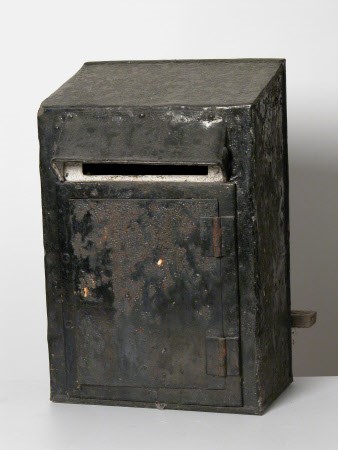
Old Letterbox at Erddig Estate, nr. Wrexham, Wales, n.d.

Dear Readers, I hope you are well.

Apologies for the lack of manual dexterity on my blog of late I have been extremely unwell, so unwell in fact I couldn’t type or at least I was trying but inventing a completely new and unintelligible language. For some self encouragement this blog is about what I will be blogging about. Things have occurred that can be written about, in spite of some of these things happening many months ago, so I decided I will write about them anyway if memory provides the ability to do so. These include a ‘medieval propaganda’ day relating to St.George at St. John the Baptist Church, Fleet Street, Coventry, a Hidden Heritage Conference in Dorset (an oxymoron I know), a visit to Burton Dassett Hills, Warwickshire, an outstanding Arts & Crafts House, Blackwell, south of Bowness, Windermere and Brantwood, Coniston Water, home of John Ruskin in the latter years of his life.

Yours

Save

Wish you Were Here: Micro Residency, Artist Researcher (Interpretation) Erddig House & Gardens

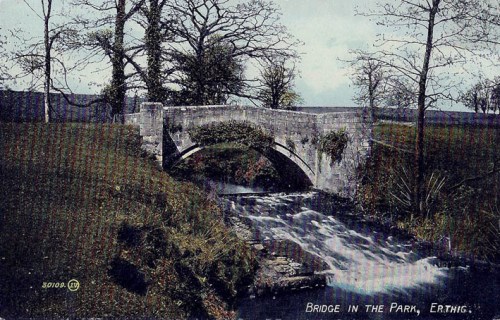
The Bridge in the Park, Erddig House & Gardens, Nr. Wrexham, Wales

The Bridge in the Park, Erddig House & Gardens, Nr. Wrexham, Wales

Micro Residency, Artist Researcher, National Trust, Archaeology Team, Erddig House & Gardens, Nr Wrexham, Wales 15th – 31st October.

In 1870-72, John Marius Wilson’s Imperial Gazetteer of England and Wales described Erddig like this:

“ERTHIG, or Erddig, a township in Gresford parish, Denbigh; on Offa’s Dyke, 2 miles SW of Wrexham. Pop., 117. Houses, 31. Erthig Hall is the seat of the Yorkes, -of whom was Philip -Yorke, author of “The Royal Tribes of Wales;” has, on the walls and ceilings of one of its rooms, the heraldic bearings of the tribes; and occupies a charming situation.” [1]

I have recently spent the week at the Yale Hostel about a mile from Erddig (pronounced Erthig) House & Gardens as Artist Researcher (Interpretation) assisting the monitoring of the Archaeological Monuments in the grounds of Erddig which has a formal walled garden and covers 485 hectares equalling 1,200 acres. The collection at Erddig is the 2nd largest in the UK, bequeathed to the Trust under the provision that no item be discarded. Supporting the Field Archaeology Team my remit is to contribute artistically to the undertaking of the Archaeological and Historic Landscape Survey at Erddig. My contribution includes A] Deep Mapping: Stories in the Landscape, B] The Map & The Territory: Utilising items in the collection to interpret the Landscape C] Documenting the Process: in a format that can be understood by the public D] Visualising and Representing the Data: making recommendations regarding the concrete representation of the Historic Buildings, Sites and Monuments Record which is essentially a digital database of the archaeological monuments in the historic parkland.

As a visual artist my artistic practice is site specific whether this site be actual, physical, textual, fictional or virtual. Both contextually and historically sensitive the role of place and place making is central to my work. Within this there is a tacit acknowledgement that the concept of place is constructed from a complex network of relations i.e symbolic, social, political, familial, local, national and historical. Place is central to the sensitive concept of belonging and home which contribute to a person’s autobiographical identity. This profoundly affects how that identity is situated and has significant impact on emotional wellbeing. Within my work I take a methodical, detailed, and extensively researched approach to the curation of material in order to construct comprehensive documents of place in the form of installed environments. In many respects I am a custodian or caretaker who respectfully recuperates, conserves and restores micro histories, narratives, objects and images that have been orphaned, discarded or forgotten. Legacy, whilst it may not always be visible, is a constant presence whether this relates to National Trust custodianship, archaeological practice, the historic parkland at Erddig, personal history or artistic practice. The rich tapestry that is art history, an artists’ conceptual trajectory, their historical timeline, the time of their work, the time of its making, the context in which one is making and their contemporaries all add up to what the literary critic Harold Bloom called, in the book of the same name, the anxiety of influence. Art does not occur in isolation, it is always made in ‘situ’. As a printmaker there is no such thing as a blank piece of paper, one always approaches it knowing that contextually, historically, artistically and technologically that it is already replete; it is a dialogue not a monologue.

Similarly the National Trust’s investment in significant cultural, historical and natural places, the people who populate them and the communities that surround them ensure our heritage is preserved as well as shared by enabling people to contribute and collaborate in its preservation. Personally speaking the research aims to investigate the intersection between art and archaeology, whereby art can also be a form of historiography that re-contextualises our relations to the past as a form of memorial or restoration. For that reason I will also be mining the art historical legacy relating to the site specific and the correlation between an aspect of historical archaeological practice and conceptual art, the concept of the grid. This concrete and in depth engagement with Erddig, generously facilitated by Kathy Laws: Archaeologist at the National Trust, will develop a more comprehensive understanding of what it means to be site specific, not just artistically & imaginatively, but historically, physically, technologically and contextually. This can only improve the depth of my work as an artist engaged with concepts of place, contexts, histories and heritage both private and public.

[1] http://www.visionofbritain.org.uk/place/3124

Review: CHORALE, A Sam Shepard Roadshow, The War in Heaven

thewarinheaven

The War in Heaven (Photograph: Nina Sologubenko) CHORALE: A Sam Shepard Roadshow, The Presence Theatre Company

The War in Heaven, Sam Shepard

“I died the day I was born and became an Angel on that day”

Whilst the non resolution of The Holy Ghostly was resolved powerfully both in terms of the scenography, the visual imagery and the performance by John Chancer this did not translate successfully in The War in Heaven which Usher describes as “a moving plea from both a fallen angel and a man struggling to be heard once more.” I would argue important contextual information was missing for the audience in the interpretation of this play especially following the The Holy Ghostly since the full title is The War in Heaven: Angel’s Monologue. Whilst The Animal You and The Holy Ghostly were connected conceptually and through the characters there was absolutely no connection to the final instalment except the fact that it was Sam Shepard’s work.

As a general rule visually I  found the scene to be completely incoherent, which in itself is not a dismissal of the aesthetic, sculptural and conceptual qualities of this kind of work and its inherent complexities however it felt largely unresolved from a formal perspective. There was simply no connection between the performers in space and the set. Clearly narrative and visual incoherence are  conceptual strategies and the production appeared to commit to this concept as an overall architecture to the work. The play itself is on many levels trying to find form through language within a stream of consciousness speech but my feeling is it didn’t go far enough and was therefore caught somewhere between the concept and the execution. If this disconnection is a formal aspect of the work it is possible to resolve the visually incoherent formally but there seemed to be a failure to commit to the intention and make it concrete.

Continue reading

Review: CHORALE, A Sam Shepard Roadshow, The Holy Ghostly

The Holy Ghostly, (Photograph: Arnim Friess), CHORALE: The Sam Shepard Roadshow, The Presence Theatre Company

The Holy Ghostly, (Photograph: Arnim Friess), CHORALE: The Sam Shepard Roadshow, The Presence Theatre Company

“Sam Shepard begins and ends with the road where the route to promise and fulfilment, or damnation seem perilously interwoven…imagine luring Beckett onto the back of  a flatbed truck with Jack Kerouac, Corso and the Beats driving across America, hard, fast and furiously in search of a new sublime.”

Contrary to my usual approach I did not do any research prior to attending the performance in order to receive it as it was given. One of the main issues that has appeared for me as a visual artist in relation to this production and my own work is the intention or challenge To explain or not to explain the work”. That is the question critical to the reception of any visual art form and this work is packed with its own explanation, visual, textual, critical and contextual. This review is my attempt to unpack the work which is fittingly existentially burdened with its own history of making. I have not reviewed the first part of CHORALE The Animal You; contrary to Beckett I couldn’t go on.

CHORALE: The Sam Shepard Roadshow is highly challenging both in terms of its visual proposition, existential subject matter and its embeddedness within the mythology of the American landscape. There is a tremendous degree of  conceptual and contextual complexity embedded in the work, not least the intricate interrelationships of the part to the whole which includes the work of the playwright Sam Shepard (The Holy Ghostly and The War in Heaven), Shepard’s relation to actor, director and writer Joseph Chaikin and in turn the director of The Presence Theatre Company, Simon Usher who first directed Chaikin in 1987 in the The War in Heaven (co-written by Shepard and Chaikin). Although the relations between these parts are writ large in the supporting material they were not contextually clear leading to a lack of clarity, certainly where the audience is concerned, in terms of the overall visual proposition (i.e 3 plays, 2 films, 1 gig). The substantial amount of depth, labour, pathos and knowledge involved in this work is, to the uninitiated, largely inaccessible. There is an effort to address this within the production itself with the inclusion of rarely seen films by Shirley Clarke of Joseph Chaikin performing Shepard’s work in Savage/Love (1979) and Tongues (1969). These were aesthetically, conceptually engaging and successful pieces of work, yet in this presentation format they were reduced to explanation, contextual props and footnotes to the production. These films were critical to an overall understanding of the work however if you had not attended the workshop during the production you would not have seen Chaikin in Tongues which I certainly felt further contextualised The War in Heaven.

Whilst it had perhaps not been the intention it was natural enough as an audience member to read the production as a trilogy and although the relations were expanded and connected in terms of the characters, mood, narrative and the overall existential highway presented in the first two instalments The Animal You (developed from the work of Sam Shepard) and The Holy Ghostly, the last instalment The War in Heaven entered an entirely different psychological and theatrical realm and I really could not understand the decision to perform the latter two plays back to back. Since the performance of The Holy Ghostly was 90 minutes this was a substantial amount of time to inhabit a particular form and location which changed direction radically in the 2nd performance (an excruciating 35 minutes) severing the connection with the audience.

The Holy Ghostly, Sam Shepard (1969)

“What if I was to tell you there was a Chindi out there with more faces and more arms and legs than the two of us put together? You really think we’re alone, don’t ya boy?” *
Continue reading