“Ted Hughes (1930-1998) was born at 1 Aspinall Street, Mytholmroyd, in the West Riding of Yorkshire on the 17th August 1930. Ted was a pupil at the Burnley Road School until he was seven, when his family moved to Mexborough, in South Yorkshire. As a child he spent many hours exploring the countryside around Mytholmroyd, often in the company of his older brother, Gerald, and these experiences and the influences of the landscape were to inform much of his later poetry.
In ‘The Rock’, an autobiographical piece about his early childhood, Hughes writes about Scout Rock, whose cliff face provided ‘both the curtain and back-drop to existence‘. The area continued to be a powerful source of inspiration in his poetry long after he had left Yorkshire. Hughes described the experience of looking out of the skylight window of his bedroom on 1 Aspinall Street onto the Zion Chapel. The Chapel is long gone, but Zion Terrace remains, its name a reminder of more God-fearing times.
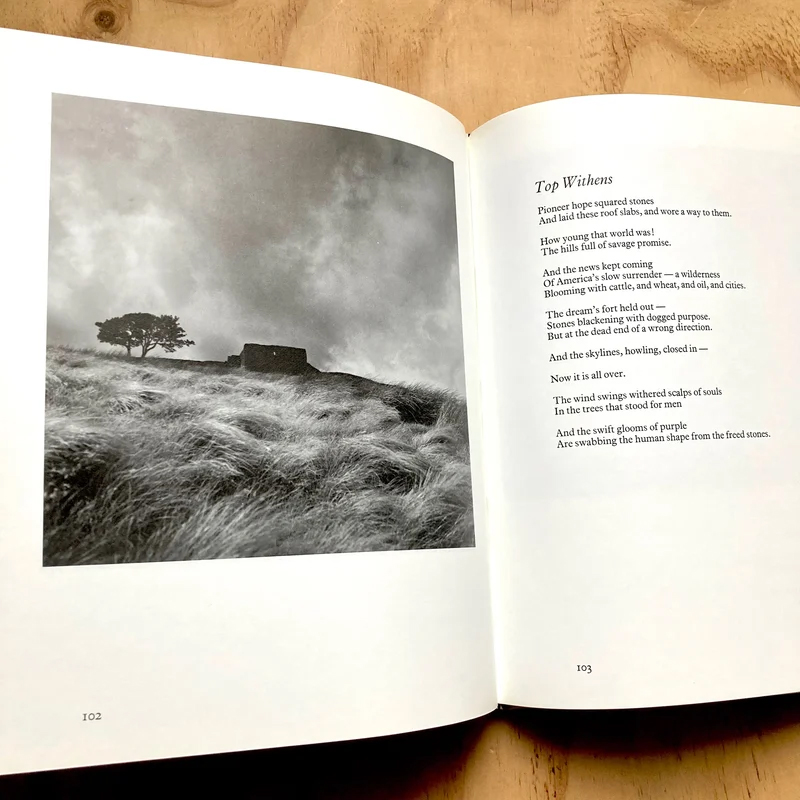
In his classic and richly personal collection Remains of Elmet: A Pennine Sequence (1979), with photographs by Fay Godwin, Hughes suggests that the Calder Valley was originally the kingdom of Elmet, the last Celtic land to fall to the Anglo-Saxons. A second, revised edition was published as Elmet in 1994.
Many of Hughes’s other poems also relate to the Calder Valley. ‘Six Young Men’, for example, was written at Hughes’s parents’ house at Heptonstall Slack in 1956. The poem describes a photograph belonging to Hughes’s father of six of his friends on an outing to Lumb Falls, taken just before the First World War.”
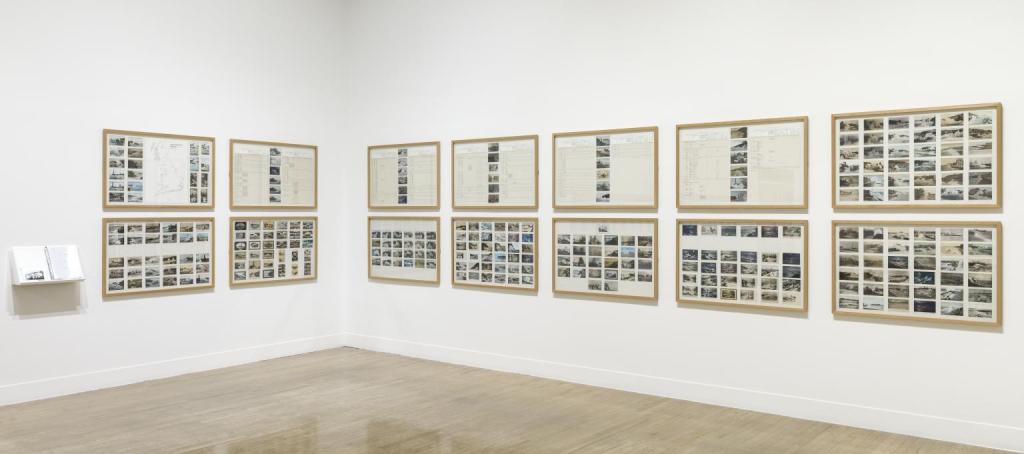
“Dedicated to the Unknown Artists 1972–6 consists of fourteen panels containing over three hundred original postcards depicting waves crashing onto shores around Britain. A large map annotated with each of the locations featured in the postcards is included in the first panel. The remaining panels have been subjected to what the artist has described as her ‘methodical-methodological approach’ (quoted in ‘Second Sight’ 2007, accessed 14 June 2018) and are organised into grids of postcards and tabulated details such as location, caption, legend, in vertical or horizontal format. Accompanying these panels are two additional components: a copy of a postcard-sized artist’s book and a dossier with supporting material, in which the artist describes herself as a curator presenting an exhibition of these overlooked cultural artefacts.
In 1977 Hiller discussed the work in the following way:
Dedicated to the Unknown Artists was designed as an exhibition piece with myself in the role of curator, collaborating with/extending the work of the unknown artists who created the Rough Sea ‘set’ of postcards. The ‘coincidental’ pairings of alternative descriptive languages – verbal and visual – are sustained as levels of presentation throughout the piece. While the charts may look like models of objectivity and the visual images like expressions of subjective internalizations, they lead to a series of paradoxes involving the unexpressed but intended vs. the expressed but unintended. (Quoted in Tate Britain 2011, p.76.)
The work illustrates Hiller’s interest in the subject of memory and memorials. The title identifies the work as a tribute to the overlooked and forgotten artists who painted, photographed or hand-tinted the numerous seaside images in the postcards she collected. By making such commonplace objects the subject of a dedicated and extensive presentation, Hiller gives new status to the mundane and provides the viewer with a familiar access point from which to engage with the work. Dedicated to the Unknown Artists has also been described as a work about invisibility (see ‘Second Sight’ 2007, accessed 14 June 2018). The group of postcards only came to exist as a ‘set’ by the artist’s act of collecting them, and the visual correspondences that the collection highlights would have been previously unseen.
Hiller’s choice of sublime or picturesque seaside motifs – with their subtext of romantic desire, the soul in turmoil, and a longing for nature – contrasts with a strict conceptual methodology. Coloured images in particular were generally excluded from contemporaneous conceptual artworks, and yet for this work Hiller opted to make the genre of popular colour postcards of the British seaside her prime focus. However, the grid formation, the serial presentation and the typed labelling all recall the language of conceptualism. Writer Brian Dillon has noted: ‘That Hiller effected a study of the invisible precisely by exhibiting objects of such ravishing (and also kitsch) visual texture is surely exactly what made the work, at the time, such a scandal for adherents of an austerely linguistic Conceptualism.’ (Brian Dillon in Tate Britain 2011, p.52.)”
Further reading Susan Hiller, exhibition catalogue, Tate Liverpool 1996, reproduced pp.12–13. Susan Hiller, exhibition catalogue, Tate Britain, London 2011, reproduced pp.52–5. ‘Second Sight’, Frieze, no.109, September 2007, https://frieze.com/article/second-sight-1, accessed 14 June 2018.
Harshness is transformed into beauty and then terror by this extraordinary film from Icelandic director Hlynur Pálmason about a 19th-century Danish pastor sent to establish a new church on Iceland’s remote south-eastern coast. I left the cinema dazed and elated by its artistry; it is breathtaking in its epic scale, magnificent in its comprehension of landscape, piercingly uncomfortable in its human intimacy and severity. There is such superb compositional sense in the still life tableau shots and the almost archaeological sense of time, creating something deeply mysterious and unbearably sad. There are echoes of Werner Herzog’s Aguirre, the Wrath of God, Roland Joffé’s The Mission, Lisandro Alonso’s Jauja – and even Howard Hawks’s Red River.
Pálmason announces in the opening credits that the story was inspired by the supposed discovery in Iceland of seven glass-plate photographs of people and places taken there at the end of the 19th century. While the claim is a deadpan fiction, his screen has an almost square 1.33:1 aspect ratio, perhaps in honour of the still photograph motif. This smaller-size, in such contradistinction to the movie’s CinemaScope ambition and spectacle, gives a density to the viewing experience.
Elliott Crosset Hove plays Lucas, a highly-strung young clergyman instructed by his bishop to travel to a pioneer community in Iceland (then a Danish dependency), superintend the church-building and install himself as parish priest. Lucas makes this arduous journey first by sea and then overland with horses, taking among his luggage a huge and burdensome cross, climbing mountains and fording rivers with it. But Lucas has a secular-ethnographic project to go with the imperial Christian mission: he dreams of taking the first pictures there, capturing the people with new technology. His cumbersome tripod goes on his back, its three spiked feet poking up behind his head, a version of the points of a crucifix. The camera is Lucas’s ordeal as he visits his stations of the cross.
Driven to the edge of madness by hardship and physical pain, Lucas has a thwarted friendship – or something more – with his translator (Hilmar Gudjónsson), and finally finds an erotic connection with Anna (Vic Carmen Sonne), the daughter of the local parishioner, who takes him in. But his life is dominated by his cantankerous, contemptuous Icelandic guide Ragnar, a tough, weatherbeaten veteran tremendously played by Ingvar Sigurdsson, the cop from Pálmason’s previous film A White, White Day. Palmasón shows that Lucas is humanised and possibly even redeemed by his encounters at journey’s end, particularly his relationship with his quasi-host, the level-headed widower Carl (a shrewdly judged performance from Jacob Lohmann), who is bemused by Lucas’s self-harming decision to come to Iceland in the most difficult way possible, and then suspicious of his potential designs on his eldest daughter. Anna’s younger sister Ida (Ída Mekkín Hlynsdóttir) has an attractively emollient role and her relationship with Lucas is gentle and sweet and brings out the nearest Lucas has to warmth.
The film’s mightiest figure is the implacable Ragnar. Far from helping Lucas across the terrain, Ragnar embodies it; he is the very personification of its hostility. As an Icelander, he hates the high-handed Dane with his book-learning. Lucas comes in turn to hate and fear him. And yet Pálmason shows that Ragnar softens imperceptibly even as he sabotages Lucas; he needs someone to confess his terror of God to while exorcising a lifetime of buried rage. In Godland, these emotions are projected out on to the stunning, daunting landscape to the accompaniment of spine-meltingly beautiful choral music. That austere, boxy screen looks like a window on to a vast, unfathomable world.
‘The Carte de Tendre or the ‘Map of Tender Love’ appeared in the 17th Century novel Clélie by Madeleine de Scudéry. It is an allegorical love map, ‘a set of instructions in love. The lover who reads such a map is, at it were, travelling on the body of his or her love.’[1] ‘The country is bisected by the Inclination a river that runs south to north, joined by two smaller rivers, Respect and Gratitude before plunging into La mer dangereuse, the Dangerous Sea (unbridled emotions) which is separated from a reef-ridden narrows, the Terres inconnues, Unknown Land.’[2] The eroticised body is fleshed out so to speak in the form of a landscape, a libidinal topography of het-erogenous zones. In The Book of Disquiet Pessoa mentions the Tender Map in relation to a ‘geography of our consciousness’ suggesting reality is a complex equivalent to ‘complicated coastlines, lakes and rugged mountains.’ [3]
1] Gandelman, Claude, Reading Pictures Viewing Texts, Indiana University Press: Bloomington and Indianapolis, USA 1991 p.81/89