Boscawen-ûn Stone Circle

So I’ve just got back from a residency in Cornwall where I was actually able to visit Lands End!. One of the ancient sites we visited was Boscawen-ûn Stone Circle.

“The site dates from the late Neolithic-early Bronze Age (approx. 2500-1500 BC) and consists of an ellipse circle of 19 stones, ranging in height from 0.9m (3ft) to 1.4m (4.5ft). One of these stones on the NE side is made of almost pure white quartz. In addition, there is an off-centre leaning stone 2.4m (8ft) high. It is not known whether this stone was always leaning at this angle or whether it has slipped over the years. In the NE side of the circle there is a jumble of stones that may have been part of a burial cist. There is a gap between stones on the W side of the circle, similar to the Merry Maidens stone circle but on the opposite side.

Folklore and Legend

Boscawen-ûn; which is Cornish for ‘elder tree on the downs’, takes its name from the nearby farm. The circle was recorded as far back as the early medieval period in the Welsh Triads, as one of the three principal gorsedds (Bardic meeting places) of the island of Britain. In 1928, the revived Gorsedd of the Bards of Cornwall was inaugurated at the site.

Purpose and Meaning

Like the other stone circles in West Penwith, it seems likely that Boscawen-ûn was a place for ceremony and ritual. It is known that quartz was seen as a sacred stone to the megalithic builders (when the central Hurlers circle was excavated on Bodmin Moor a whole layer of quartz foundation stones were found), so the quartz stone in the circle may have had some significance relating to healing and perhaps the moon. The fact that the circle, like others in West Penwith, had 19 stones may also relate to the 18.64 year cycle of the moon, or the 19 year metonic cycle of the moon and sun. Also, the centre stone faces in the direction of the midsummer solstice sunrise, towards an outlying standing stone, and the rising sun at midsummer illuminates a carving of two axe-heads that lie towards the base of the stone. Axes were important to the Neolithic and Bronze-Age peoples as ritual objects, and Cornish greenstone axes were traded with other tribes in England and elsewhere, so this carv- ing on the centre stone is probably a sacred symbol. In the other direction, the sun can be viewed setting between the centre and quartz stones at Samhain (Oct 31st), a pre-Christian festival, when viewed from a spot on the opposite side of the circle.

Boscawen-ûn (prounounced Bosca-noon) Stone Circle lies to the south of the main A30 road between Penzance and Land’s End about a mile before Crows-an-Wra. OS grid reference SW 4122 2736.”

Text reproduced from https://cornishancientsites.com/ancient-sites/boscawen-un-stone-circle/ , image reproduced from https://www.isleofalbion.co.uk/sites/14/boscawen_un.php (accessed 22/11/23)

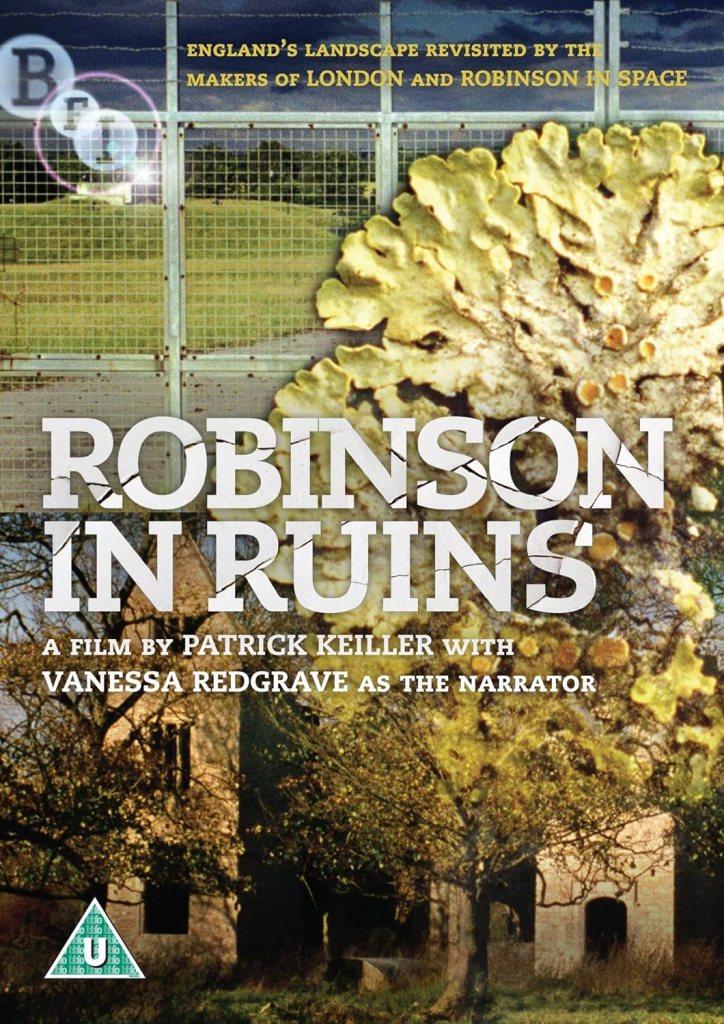
Robinson in Ruins

“The opening sentence of Patrick Keiller’s new film, voiced with laconic precision and italic irony by Vanessa Redgrave, is calculated to quicken the hearts of admirers of Keiller’s enigmatic oeuvre: “When a man named Robinson was released from Edgecote open prison, he made his way to the nearest city and looked for somewhere to haunt.” Robinson in Ruins is the third of Keiller’s feature-length essay-fictions to deposit his eccentric protagonist among the relics of millennial England, where he functions once more as the comically half-deluded conduit for the director’s own brand of visionary scholarship. As a fictional invention, the autodidact aesthete Robinson, whom we only ever encounter via the films’ narrators’ vexed relations with him, is an absurd sort of wraith, tricked up from reminders of Defoe and Céline, but surely also a descendant of the Regency showman Robertson, inventor of the proto-cinematic phantasmagoria. In Robinson in Ruins, his spectral patch is the landscape around Keiller’s own home in Oxford: its industrial heritage, its residual romanticism, the weird energies of Englishness at a time of global economic collapse.

In successive close-ups, a patch of lichen on an Oxford road sign comes to resemble the profile of Goethe. Robinson, at large among the relics of military-industrial technology, eventually settles on a disused cement works, crumbling into romantic ruin, as the potential site of a new utopian community. The history of clearances and land riots ghosts the new landscape of PFI follies, unpeopled agribusiness and the amnesiac transformation of every fraught patch of land (Greenham Common included) into a Site of Special Scientific Interest. All of this is rendered, meanwhile, with Keiller’s customarily austere but rapt visual style – though in this case, as suits a film partly about the persistence of pastoral in the face of rapacious land grabs, the shots are longer. The camera tarries with fields of oil seed rape, nodding foxgloves and shivering primroses until they start to look monstrous, every bit as alien as the relics of 19th-century architecture and décor that so exercised the surrealists. Before Keiller’s (or Robinson’s) prophetic gaze, the English countryside is a monument to itself, and ripe for revolutionary appropriation.”

Text reproduced from https://www.theguardian.com/film/2010/nov/20/robinson-ruins-patrick-keiller-dillon (accessed 18/09/23)

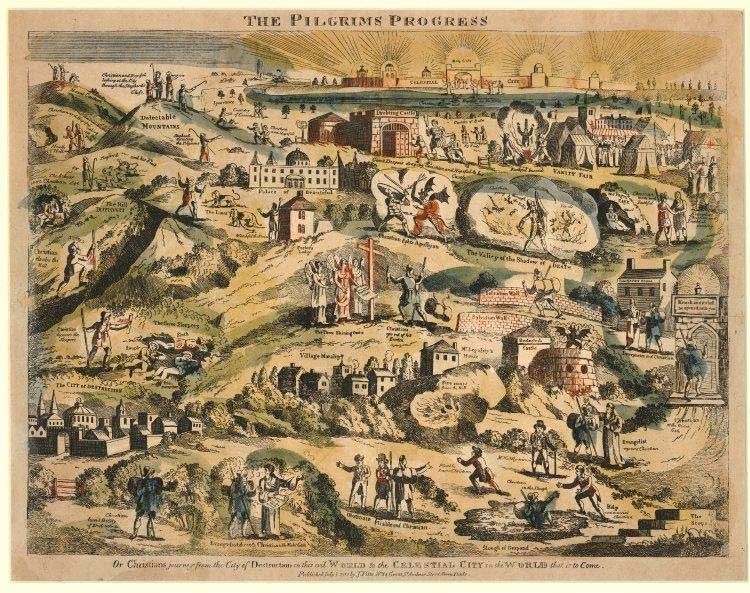
The Pilgrims Progress

“The Pilgrims Progress, or, Christians Journey from the City of Destruction in This Evil World to the Celestial City in the World That Is to Come” ([London]: Published . . . by J. Pitts, no. 14 Great St. Andrew Street Seven Dials, July 1, 1813). Copperplate map, with added color, 34 × 45 cm, on sheet 41 × 51 cm [Historic Maps Collection].

“This anonymous map visually interprets English preacher John Bunyan’s religious allegory The Pilgrim’s Progress from This World to That Which Is to Come: Delivered Under the Similitude of a Dream, Wherein Is Discovered the Manner of His Setting Out, His Dangerous Journey, and Safe Arrival at the Desired Countrey (1678). (The book was probably written during his imprisonments for preaching without a license.) The protagonist, named Christian, faces temptations and digressions that could prevent him from reaching his goal, God’s celestial city. The symbolic nature of the work lends itself to graphic illustration: the Slough of Despond, the Valley of the Shadow of Death, Vanity Fair—such “obstacles” have become iconic in Western literature. The universal resonance of Bunyan’s work—it has been translated into more than two hundred languages—accounts for its never having been out of print.”

Image reproduced from https://www.biola.edu/blogs/good-book-blog/2019/pilgrim-s-progress-maps (accessed 14/09/23). Text reproduced from https://library.princeton.edu/visual_materials/maps/websites/thematic-maps/theme-maps/literature.html (accessed 14/09/23)

Boodle Hatfield Printmaking Prize 2023


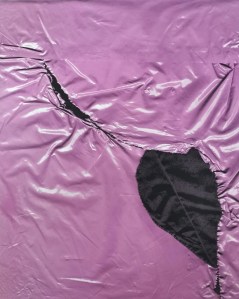
I am pleased to announce I will be attending the Boodle Hatfield prize giving evening next month in London. I was one of 10 shortlisted artists to be selected last year at the Woolwich Contemporary Print Fair for my print Total Eclipse of the Heart, Screenprint, 76cm x 56cm, 1/15. On the day all the works will be displayed in the Boodle Hatfield Offices, there is a Q & A with each artist and then the winner is announced. The winner then receives a solo booth at Woolwich Contemporary Print Fair 2024. Wish me luck!

Parallax

[“It’s dark in here.”] [“Who said that?”]

Silent gravel in the driveway, deafening clock in the hall, everything whispers anxiously. A back is turned to hide its increasing anxiety, compulsive shrugs walk away. In the distance doors exploded from their origin, nothing is being asked or explained. A serene velocity at the mirrors edge hovers in the silver of the ground. The ghostly sublime of a chair hovers in the background then I realised it never went away because it was never there in the first place. A wispy ballad suddenly bursts, brilliantly unique and uniquely brilliant. Lugubriously strings swayed, a power cable fell down, every act efficient as part of its attempt to keep itself alive. The controlled frenzy of the climax seemed all the more potent for its restraint. Compression of ground prevents working within deeper structures  where we dance the rain.

[Oscillating sensations]

An illusion that converts one material into the signifier for another along dislocated points of reference. This is the trap, an anterior document, a document created to sustain an image, an image contained in a scene, a scene without a referent. The wall urges you to remember your compulsion to forget, a psychic event reveals an excess of meaning, a riddle whose clues and secrets are hidden, suppressed by namelessness. This absent content is a fragment that shines like gold. There is no sound we can run to in this prototype theatre, we can only act out to the sides. Blind rage mixes with helter skelter theories and confessional interludes. Appetite runs while reason runs behind, at times this is immensely affecting….beware rollercoaster effects. 

A living creature seeks to fill an empty refuge  where one shining quality lends lustre to another or hides some glaring defect; the act of perception is an act of consumption in which we hazard nothing. Symptoms manifested in the smashing of  windows, the rehearsal of a ventriloquist act in adjoining rooms constructing an emotional temperature… I have tried to inflect my icon with a blank magic.