Landing Sites > Arakawa and Gins

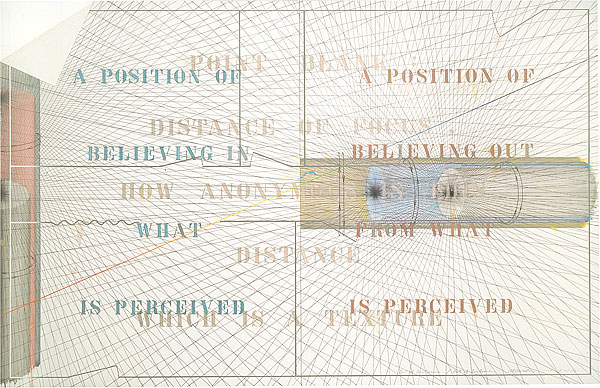
Shausaku Arakawa_Out of distance / Out of texture
[Distance of point blank B]

 “Were nothing being apportioned out, no world could form. What is being apportioned out no-one is able to say. That which is being apportioned out is in the process of landing. To be apportioned out involves being cognizant of sites. To be cognizant of a site amounts to having greeted it in some manner or to having in some way landed on it. There is that which gets apportioned out as the world. There is an apportioning out that can register and an apportioning out that happens more indeterminately. A systematic approximating of how things are apportioned out should be possible.

The body is sited. As that which initiates pointing, selecting, electing, determining and considering, it may be said to originate (read cooriginate) all sites. Organism-person-environment consists of sites and would-be sites. An organism-person, a sited body, lives as one site that is composed of many sites.”

For more information about the work of the artist Arakawa and Madeline Gins, artist, architect, poet and their architectural poetics in The Mechanism of Meaning please click here

Text reproduced from Architectural Body, Chapter 2 Landing Sites, MadelineGins and Shausaku Arakawa, The University of Alabama Press, USA 2002:pp.5

Image reproduced from http://nga.gov.au/international/Catalogue/Detail.cfm?IRN=74725&ViewID=2&GalID=ALL

John Latham

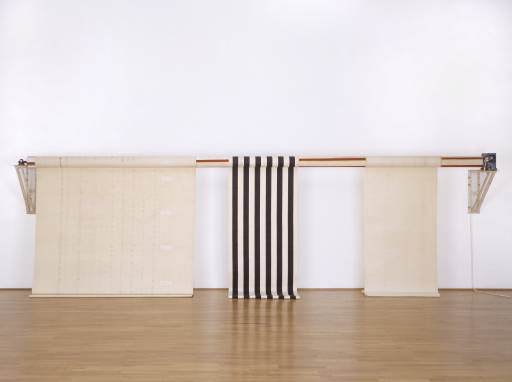
John Latham Time based roller 1972

The rollers, or blind paintings, made between 1963-67, were an attempt by the artist to physically embody time in painting.  “Latham adopted the roller format because it enabled him to represent time as a passing effect and time as a state which does not change, to encapsulate the relationship between the present moment and a whole event (a life or a universe): if the rectangle of canvas represents a whole event, then the narrow strip of canvas exposed along the roller represents the present moment. When the canvas is rolled up, the whole event is still there but hidden from view.”
(John A. Walker, ‘John Latham, The Incidental Person’, Middlesex University Press, 1994)

In 1972 Latham made the Time-Base Roller (now in the Tate Collection), three lengths of canvas along a 6m long cylinder. This time he included a numbered spectrum along the horizontal axis of the Roller, with a ‘least event’ represented at Band 1 on the left hand edge, and the universe as event at Band 36 on the right. Between these two extremes, the spectrum allows for the understanding of all cosmological, geological or spiritual phenomena, all physical, emotional or psychological states within the same system.

Text reproduced from http://www.flattimeho.org.uk/project/31/

Image reproduced from http://www.tate.org.uk/servlet/ViewWork?cgroupid=999999961&workid=83954&searchid=9838&roomid=false&tabview=image&imageid=357256