
A Curious Love Letter © Denise Startin
A Curious Love Letter © Denise Startin

60,000 Miles
There was an old woman who lived in a shoe.
Dear Reader[s]?
[Hello, is there anybody out there?]
I can only apologise for the lack of activity on my blog lately. I hope that my shoes are ample proof I have been far from idle. In fact I feel how my shoes look or do I in fact look how my shoes feel? These shoes have been worn throughout and worn out by my time at the Royal College of Art. I was hoping they would make it to the end but unfortunately they failed to toe the line and even I had to concede that I had to stop wearing them a] because my partner pleaded and b] when someone offered me money on the street. For the last 2 years – 730 days – 24 months – 104 weeks – 17,532 hours I have thought about and done nothing other than work my socks off (and shoes literally) on the MA whilst my partner has stared at 60,000 miles of tarmac travelling from A] here to B] there and back again.
The context of my current body of work is The Labour of Love and I can say that we have both performed it even if more often than not I was at A] here and he was at B] there. There is simply no other rational explanation for it. I’m afraid there will possibly be no rational thought (how can there be when running around like a loon has become recreational?), semblance of humanity (see above) or blogging until the last nail is in the wall and maybe even some time after that.
Yours

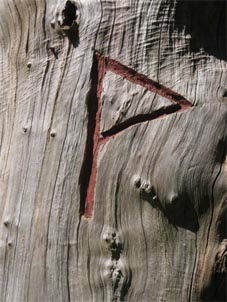
© Denise Startin
Herst Henge or Wood Henge exists in the Gardens of Herstmonceux Castle. The trees are carved with encoded rune messages. This is the symbol for WYN = Joy and Happiness, the transforming of life for the better. There were 7 symbols in total. The overall interpretation was given thus: “Herst Henge incorporates all the meanings of the runes and translates them into the context of the site. Herst Henge is a place of rest and relaxation, when someone enters into the ring, they will feel that they are experiencing a new beginning in their life, a sense of revitalization will prevail. Herst Henge is a circle of protection and anyone spending time within the circle will feel empowered and able to depart on a new and challenging time in their life with increased physical and mental energy.”
It certainly was a beautiful place but I think after an exceptionally stressful year I would have needed to just stay in the circle ad infinitum. Hopefully if you meditate on this image a sense of revitalization will prevail for you, if it does let me know.! “Herstmonceux is renowned for its magnificent moated castle, set in beautiful parkland and superb Elizabethan gardens. Built originally as a country home in the mid- 15th – century, Herstmonceux Castle embodies the history of Medieval England and the romance of Renaissance Europe.” Herstmonceux Castle is in Hailsham, East Sussex. [This is not a one horse town, this is a one gnat town but very handy for Eastbourne and Hastings where they do the most excellent fish and chips!]
Rune text quoted from signage in Herstmonceaux castle gardens. Text quoted from http://www.herstmonceux-castle.com/index.php
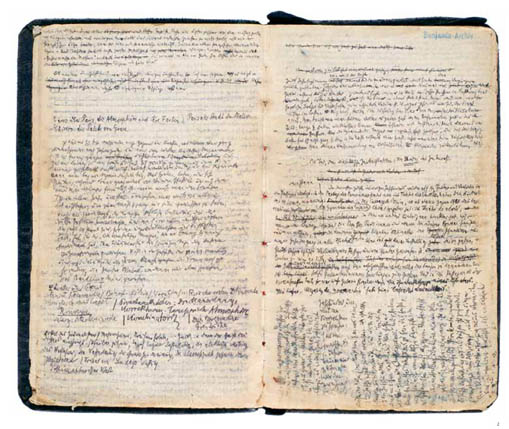
Walter Benjamin, Pariser Passagen
In the Field Guide To Getting Lost Rebecca Solnit quotes a question from the pre-socratic philosopher Meno. “How will you go about finding that thing the nature of which is totally unknown to you?” p.4 […] and goes on to write “To lose yourself: a voluptuous surrender, lost in your arms, lost to the world, utterly immersed in what is present so that its surroundings fade away. In Benjamin’s terms, to be lost is to be fully present, and to be fully present is to be capable of being in uncertainty and mystery. And one does not get lost but loses oneself, with the implication that it is a conscious choice, a chosen surrendering, a psychic state achievable through geography.” p.6
The current exhibition at the British Library 25th September celebrates this psychic state through the relationship of writing in Britain. Exhibits include extracts from diaries, notebooks, letters, artworks and sound recordings from a wealth of poets and writers including William Blake, Ted Hughes, George Eliot, James Joyce, J G Ballard, John Lennon, Harold Pinter and more. Writing speaks of walking and wandering [wondering], of finding and losing, of coming and going, of boundaries and horizons, pilgrimages and wild places. Writing and landscape mark each other reciprocally producing dream landscapes, barren landscapes, hostile landscapes, loving landscapes and sacred spaces where the human being who is most of the time caught up in human doing, can take time out and dwell [in the Heideggerian sense of the term] in being. To experience its chthonic heartbeat and return itself to its natural rhythms through walking and what is writing if not a walk on the wild side?
The title of this quote is reproduced from the exhibition and is from J.R.R. Tolkien, The Fellowship of the Ring.
Quotes reproduced from Rebecca Solnit, A Field Guide to Getting Lost, Canongate Books 2011. Image reproduced from http://www.hatjecantz.de/controller.php?cmd=detail&titzif=00002894&lang=en

“Can you ever forgive me for posting this delightfully corny image?” I had almost forgotten how I got here and then realised it had been produced by a search for images of Rebecca Horn. Hence a combination of surrealist chance and google images produced French Horn with Mouse [or Mouse with French Horn].
John Cale of the Velvet Underground is playing in the background [Fragments of a Rainy Season] and I am reading about writing, techné and female sexuality and this image provided a little light-hearted relief. Could it be that somewhere deep in Dissertation Land there is a mouse playing a french horn?.
Image reproduced from http://rakstagemom.wordpress.com/tag/the-nutcracker/ [there is very little here about the genesis of this image.]

