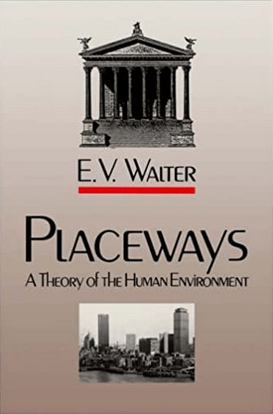
“Placeways is a philosophical and historical interpretation of the experience and meaning of place. Searching for a way of knowing and living in the world that does not fragment experience or exploit the environment, E. V. Walter explores the way people in other cultures and other times have experienced place. The book develops Walter’s theory of topistics – a holistic way of grasping a place as the location of shapes, powers, feelings, and meanings. Exploring the common ground of such diverse fields as philosophy, history, urban planning, classics, cultural geography, architecture, sociology, and environmental psychology, Walter provides theoretical resources for readers who want to rescue the human environment from the loss of feeling and meaning. Walter discusses a wide variety of places, from prehistoric caves, the Australian desert, and classical Greece to medieval towns, Renaissance cities, and modern slums. He examines the changing realities of expressive space and reveals the nonrational, symbolic, and intuitive features in our experience of places – elements taken for granted by archaic peoples but discounted by modern civilization. The current crisis of environmental degredation, according to Walter, is also a crisis of places. For the first time in human history, people are systematically building meaningless places. If we are to comprehend and reverse the ruin and dislocation of our cities, we must develop another way of understanding the built environment and the natural landscape. True renewal, Walter says, will require a change in the way we structure experience and a return to an ancient paradigm for understanding both the natural land and the constructed world.”
Text and image reproduced from https://www.amazon.co.uk/Placeways-Theory-Environment-V-Walter/dp/0807842001 (accessed 01/10/22)
 denisestartin.co.uk