Letters of Motivation – Move[ME]nt

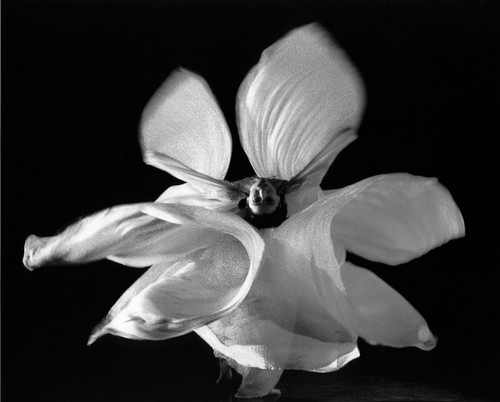
Loïe Fuller & The Serpentine Dance, physical poet, 1862-1928

Loïe Fuller & The Serpentine Dance, physical poet, 1862-1928

things shifting, slowly, imperceptibly, m-o-o-o-ving, don’t…know…where to…a movement toward […] away…shifting…things appearing…vanishing…[sub] emerging…it might be too soon to say “A Denise”…might be a “A…might be “A…D…might just be ” but at least that is a start…an opening

[flashing cursor on the screen as I pause then press return…and move…toward…

…uncertain steps, uncertain of his convictions, unsure of herself and…]

her future, an uncertain smile seeking a point at which rays of light converge as they simultaneously diverge, searching for the distinctness or clarity of an image rendered by an optical system in the act of moving,

a change in place
or
position, the focus of a lens, whir-click, click-clack

touching the ornaments – knick-knack – with uncertain fingers – touch, brush, tap, tap, tap…tick…tock, hearing the driving and regulatory mechanism of a watch or a clock, a movement toward, finding in the rhythmic structure of movement a self contained symphony…

a series of actions and progressive events, a centre of interest and a movement toward,

move as smoothly as wind across water, move listlessly, move quick and light, move like a flightless bird, like a shoal of silver fish, dart, descend, drift, float, glide, move as if on a treadmill to the centre of interest and a movement

toward the distinctness or clarity of an image,

pace, rush, scamper, shuffle, c-r-e-e-e-e-e-p, glide like a shadow|shadow, twist, travel, totter, hover […]

like a woman uncertain of his convictions, unsure of herself, an uncertain smile groping in the dark for the sub-conscious memory of a rhythmic structure of movement – toward – a self contained symphony.

uncertain seeking, unsure future, uncertain convictions, taking uncertain steps to a point…to a point…to a point…to a point…to a point…to to to the point at which rays of light simultaneously converge and diverge –

move[ME]nt.

Foot Notes

Artists Foot Notes © My Sole

Loïe Fuller image reproduced from https://bibliolore.org/2013/05/20/loie-fullers-serpentine-success/
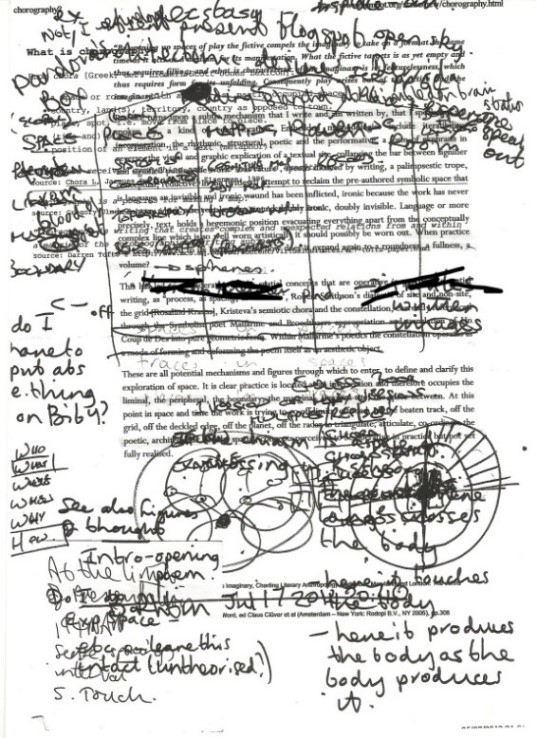
Incommunicado

November2012 006

© Denise Startin

Dear Reader

Many apologies for the lack of continuous activity on the blog of late. Having recently produced a thesis for the MA I am undertaking (the effect of which has been to somewhat ironically kill my voracious writing and reading habits) the process has left me textually satiated, linguistically engorged and physically sick.

The thesis was part performative, part theoretical, part confession, part autobiography (which of course is a fallacy since one can only live one’s life not write it).The philosopher Phillipe Lacoue-Labarthe develops this rhythmic train of thought particularly in relation to autobiography and music; ‘the need to tell, to confess, write oneself.’ [1] Perhaps having partly written myself into textual oblivion through examining my haecceity one has been left comparatively mute. To draw upon an analogy  between writing and excrement ‘I’ have been evacuated. ‘I’ write myself, ‘I’ kill myself (after Derrida).

In Footnote 115 of the thesis I discussed the relation of the textual fetish and desire, here I quote myself “Elizabeth Grosz explains there are ‘two conceptions of desire – negative and positive.’ The one that concerns us here in relation to Freud and Lacan is desire as lack, that is ‘a yearning for what is lost, absent, impossible. Desire is posited as an economy of scarcity, where reality itself is missing something (the object whose attainment would yield completion), a linked to the death drive (the struggle for mutual recognition) and annihilation (which the object of desire threatens). Continue reading

Word Flesh

Pre/face © Denise Startin

FLASH – an instant of time or a timeless dream; atoms swollen beyond measure, atoms of a bond, a vision, a shiver, a still shapeless embryo, unnameable. Photo’s of what is not yet visible and which language necessarily surveys, from a very high altitude elusively. Words always too remote, too abstract to capture the subterranean swarm of seconds, insinuating themselves into unimaginable places.

Writing them down tests an argument, as does love. What is love for a woman, the same thing as writing. Laugh. Impossible. Flash of the unnamable, woven of abstractions to be torn apart. Let a body finally venture out of its shelter, expose itself in meaning beneath a veil of words. WORD FLESH.  From one to the other, eternally, fragmented visions, metaphors of the invisible.”

Stabat mater, Julia Kristeva quoted in The Female Body in Western Culture: Contemporary Perspectives, Susan Rubin Suleiman, Harvard University Press, 1986 p.99/100

Not all those who wander are lost

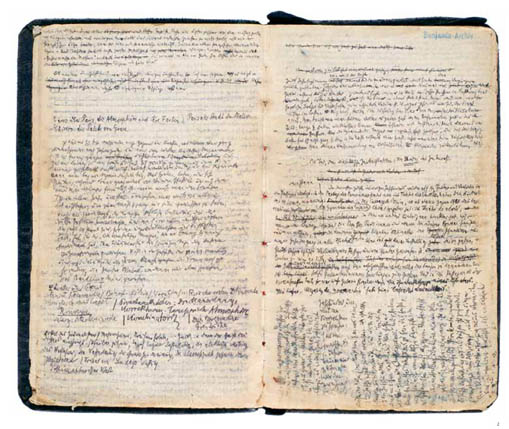
Walter Benjamin, Pariser Passagen

In the Field Guide To Getting Lost Rebecca Solnit quotes a question from the pre-socratic philosopher Meno. “How will you go about finding that thing the nature of which is totally unknown to you?” p.4 […] and goes on to write “To lose yourself: a voluptuous surrender, lost in your arms, lost to the world, utterly immersed in what is present so that its surroundings fade away. In Benjamin’s terms, to be lost is to be fully present, and to be fully present is to be capable of being in uncertainty and mystery. And one does not get lost but loses oneself, with the implication that it is a conscious choice, a chosen surrendering, a psychic state achievable through geography.” p.6

The current exhibition at the British Library 25th September celebrates this psychic state through the relationship of writing in Britain. Exhibits include extracts from diaries, notebooks, letters, artworks and sound recordings from a wealth of poets and writers including William Blake, Ted Hughes, George Eliot, James Joyce, J G Ballard, John Lennon, Harold Pinter and more. Writing speaks of walking and wandering [wondering], of finding and losing, of coming and going, of boundaries and horizons, pilgrimages and wild places. Writing and landscape mark each other reciprocally producing dream landscapes, barren landscapes, hostile landscapes, loving landscapes and sacred spaces where the human being who is most of the time caught up in human doing, can take time out and dwell [in the Heideggerian sense of the term] in being. To experience its chthonic heartbeat and return itself to its natural rhythms through walking and what is writing if not a walk on the wild side?

The title of this quote is reproduced from the exhibition and is from J.R.R. Tolkien, The Fellowship of the Ring.

Quotes reproduced from Rebecca Solnit, A Field Guide to Getting Lost, Canongate Books 2011. Image reproduced from http://www.hatjecantz.de/controller.php?cmd=detail&titzif=00002894&lang=en