Adam Phillips

A Repertoire of Repetitions

‘…A life as an idiosyncratic repertoire of repetitions; and the account of the life always already ironised by the Freudian knowingness of the narrator. The details of a life, of course, can never be predicted; nor can the content or the exact working of the repetitions [ ]. But what can be assumed is that there will be repetitions, and that these repetitions found their initial and initiating) forms in childhood. …[ ]. Our lives may be turbulent, but it is a patterned, if not actually a structured turbulence.’
Adam Phillips; Childhood Again, Equals, Faber & Faber, London 2002

Text quoted from http://www.judithclarkcostume.com/exhibitions/victoria_albert_01.php

Cy Twombly

Cy Twombly, Untitled 1970. Oil-based house paint and crayon on canvas. The Museum of Modern Art, New York. Photo: © 2004 Matthew Septimus

 
‘Post-Scriptum.

It has been said that Cy Twombly’s paintings resemble writing, or are a kind of écriture. Certain critics have seen parallels between his canvases and wall graffiti. This makes sense. In my experience, however, his paintings refer to more than all the walls I pass in cities and gaze at, or the walls on which I too once scrawled names and drew diagrams; his paintings, as I see them, touch upon something fundamental to a writer’s relationship with her or his language. Continue reading

Heraclitus

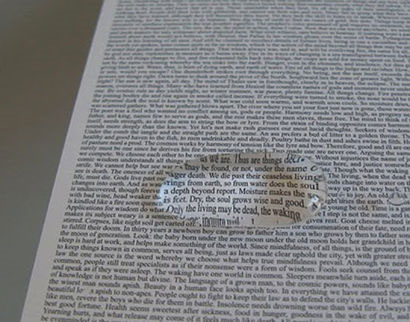
Josh Baum Reading Heraclitus

Browsing the fragments of Early Greek Philosophy by Heraclitus, Empedocles and Diogenes et al I have made some startling and humorous discoveries of the thoughts of Heraclitus inscribed here for your delectation:

‘Exhalations are given off by the earth and the sea, some of them bright and pure, others dark. Fire is increased by the bright exhalations, moisture by the others. He does not indicate what the surrounding heaven is like. But there are bowls in it, their hollow side turned toward us […] The sun and the moon are eclipsed when the bowls turn upwards. The moon’s monthly changes of shape come about as its bowl gradually turns.

and here in this combination of the comic and the tragic:

‘In the end he became a misanthrope, leaving the city where he fed on plants and herbs. Because of this he contracted dropsy and returned to the town. He asked the doctors in his riddling fashion if they could change a rainstorm into a drought. When they failed to understand him, he buried himself in a byre [barn, cowshed], hoping that the dropsy would be vaporized by the heat of the dung. But he met with no success even by this means and died at the age of sixty.’

Barnes J, Early Greek Philosophy, Penguin, London, 1987:pp 107, 105

Image by Josh Baum reproduced from http://futuremap.arts.ac.uk/press/joshbaum-reading-heraclitus/