John Latham

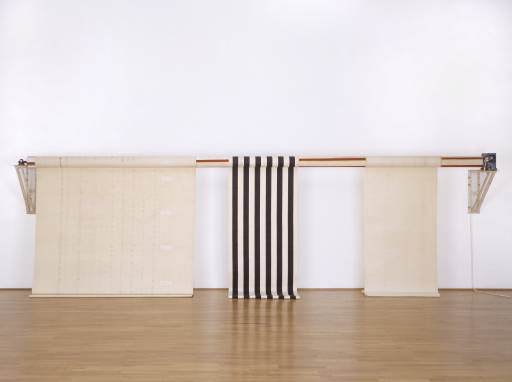
John Latham Time based roller 1972

The rollers, or blind paintings, made between 1963-67, were an attempt by the artist to physically embody time in painting.  “Latham adopted the roller format because it enabled him to represent time as a passing effect and time as a state which does not change, to encapsulate the relationship between the present moment and a whole event (a life or a universe): if the rectangle of canvas represents a whole event, then the narrow strip of canvas exposed along the roller represents the present moment. When the canvas is rolled up, the whole event is still there but hidden from view.”
(John A. Walker, ‘John Latham, The Incidental Person’, Middlesex University Press, 1994)

In 1972 Latham made the Time-Base Roller (now in the Tate Collection), three lengths of canvas along a 6m long cylinder. This time he included a numbered spectrum along the horizontal axis of the Roller, with a ‘least event’ represented at Band 1 on the left hand edge, and the universe as event at Band 36 on the right. Between these two extremes, the spectrum allows for the understanding of all cosmological, geological or spiritual phenomena, all physical, emotional or psychological states within the same system.

Text reproduced from http://www.flattimeho.org.uk/project/31/

Image reproduced from http://www.tate.org.uk/servlet/ViewWork?cgroupid=999999961&workid=83954&searchid=9838&roomid=false&tabview=image&imageid=357256
T.S Eliot

‘We shall not cease from exploration

And the end of all our exploring

Will be to arrive where we started

And know the place for the first time.’

T.S eliot quoted from the end of Little Gidding. Text reproduced from Spatialities: The Geographies of Art and Architecture:pp72

Framing and Identity in Conceptual Poetics

Framing and Identity in Conceptual Poetics

At the recent Conceptual Poetics Symposium at the Poetry Center of the University of Arizona the key word seemed to be “framing.” The idea that words could be objectified to erase the identity of the writer–or to redefine what writing is–was explored through the notion of arrangement. This aesthetic sees words as objects to be placed in various structures through “language games” and distinguishes itself from an aesthetic in which the writer arranges the words as they represent his or her experience. In Conceptual Poetics, its practitioners argue, writing is freed from the limitations of one subjective viewpoint–the “lyric I” of confessional or romantic writers. Words are out there for anyone to place into “formal constraints.” What I found most interesting was the idea of subjectivities–the notion of replacing the “Lyric I” with several points of views or eyes looking out through various frames. The tools of technology allow poets to release the poem from the printed page and create hybrids with art, music, video games–whatever suits the “eye’s” fancy. To paraphrase one of the poets as he framed his chin and top of his head with his hand, what do we do with this space? The gesture conveyed visually that “this space” is a place from which to look out, not to look within. Continue reading