The Gender of Place: Angela Carter, The Bloody Chamber

“The faery solitude of the place…his castle that lay on the very bosom of the sea…. evanescent departures of the ocean, cut off by the tide from land for half a day…at home neither on land or water, a mysterious amphibious place, contravening the materiality of both earth and waves…That lovely, sad, sea-siren of a place!." The Blood Chamber, p.8-9

“The faery solitude of the place…his castle that lay on the very bosom of the sea…. at home neither on land or water, a mysterious amphibious place, contravening the materiality of both earth and waves…That lovely, sad, sea-siren of a place!.” The Bloody Chamber, p.8-9

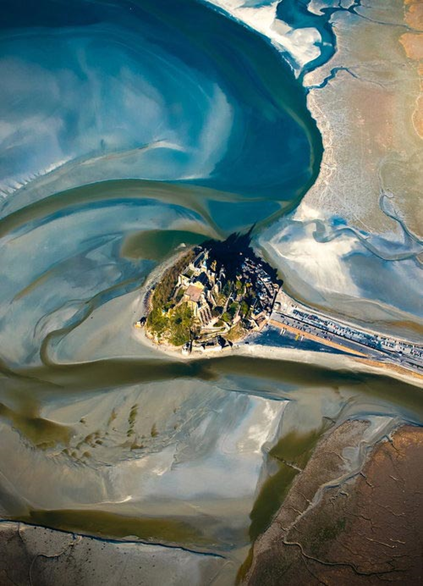
This very brief analysis explores how we can approach gendered relations from the perspective of location to reveal the symbolic and metaphorical significance of Mont. Saint- Michel as it is employed in Angela Carter’s The Bloody Chamber. This analysis was given recently in a very short presentation. Examining Mont. Saint- Michel I explore its potential to represent feminine and masculine principles, nature and culture and how it is central to relations between the bride, her mother and the Marquis. Working through visual and sonic imagery highlights the relations between female anatomy, biology and the cyclical feminine flow ontology of the ‘sea-girt’. My interest lay specifically in the concept of the sea-girt, as a border or boundary surrounded or enclosed by the sea and how we might consider this in relation to the porous and the feminine. Continue reading

Metamorphosis of the Feminine – The Bloody Chamber by Angela Carter

Georges Méliès, Bluebeard, 1901.

Georges Méliès, Bluebeard, 1901.

The following essay performs a close textual reading of two extracts from Angela Carter’s, The Bloody Chamber. Given the constraints of the assignment [1,000 words] this is a rather crude analysis which, unable to unpack its implications, leads in some respects to the generic and the obvious. In spite of these concerns I have nevertheless aimed for perceptual depth. Since the two passages are analogous I have privileged the former while drawing upon the latter. Rather than litter the post with copious footnotes you can read the Angela Carter Extracts here.I have given the page numbers for reference.

“His wedding gift, clasped round my throat. A choker of rubies, two inches wide, like an extraordinarily precious slit throat.” [p.6]

Carter’s employment of language here is extremely precise. The idea of clasping, of holding fast suggests power and possession (to have and to hold until death do us part?), as if the Marquis’ hands are literally round her throat. If we read this metaphor as asphyxiation, of becoming unable to breathe, and the ‘choker’ as a restriction of the body, particularly the neck (an erogenous zone) and vocal cords this would also increase the awareness of one’s own body as an object. His apparent gift is not just a symbol of wealth but a contractual exchange to which the female protagonist is committed by receiving and wearing it. At this point the choker metaphorically pre-figures the female protagonists fate in the final act and what appears to be her inevitable decapitation.

Continue reading

Walk On, MAC Arts Centre, Sat 8th Feb-Sun 30th Mar 2014

Published  by J. Pitts, no. 14 Great St. Andrew Street Seven Dials, July 1, 1813). Copperplate map, with added color, 34 × 45 cm, on sheet 41 × 51 cm. Unknown Author

“The Pilgrims Progress, or, Christians Journey from the City of Destruction in This Evil World to the Celestial City in the World That Is to Come”. Published by J. Pitts, no. 14 Great St. Andrew Street Seven Dials, July 1, 1813. Copperplate map, with added color, 34 × 45 cm, on sheet 41 × 51 cm. Unknown Author.

  “The geography of our consciousness of reality is one of complicated coastlines, lakes and rugged mountains.”

Fernando Pessoa, The Book of Disquiet, Serpents Tail: London 1991, pp.147

In perfect peripatetic timing with the exhibition at the Mead Gallery, Uncommon Ground, Warwick Arts Centre,  Sat 18 Jan – Sat 8 Mar 2014 Walk On at the MAC celebrates 40 years of Art and Walking. The exhibition seeks to examine the myriad ways that artists “since the 1960’s have undertaken a seemingly universal act – taking a walk – as their means to create new types of art. The exhibition proposes that, across all four of the last decades, artists have worked as all kinds of explorers, whether making their marks on rural wildernesses or acting as urban expeditionaries. The exhibition brings together nearly 40 artists who all make work by undertaking a journey on foot. In doing so, they all stake out new artistic territories. Featured Artists include Francis Alÿs, Richard Long, Hamish Fulton, Julian Opie, Bruce Nauman, Marina Abramovic, Sophie Calle, Janet Cardiff, Melanie Manchot, Tim Robinson, Carey Young, Tim Brennan, Mike Collier, Brian Thompson, Alec Finlay, Chris Drury, Dan Holdsworth and Richard Wentworth to name a few.” Continue reading

Mapping the Itinerary 2014

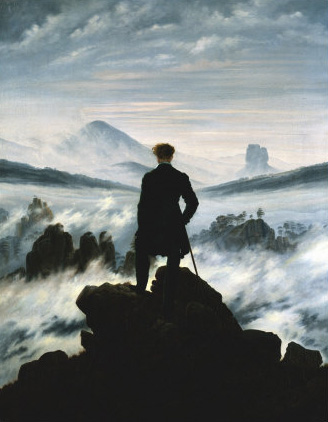
Caspar David Freidrich, The Wandered above a Sea of Fog, c.1818

Caspar David Freidrich, The Wanderer above a Sea of Fog, c.1818

“Resolve to perform what you ought and perform without fail what you resolve.”

Benjamin Franklin

Hello Every Bodies and welcome to the New Year here at F=R=A=G=M=E=N=T=S.

Since I have now acclimatised to my new surroundings and the concept or being post-institution, at least as far as my art education is concerned, it is my intention that this year be highly strategic. Thanks to the public institution of the Royal College of Art this private institution, active membership of one, has a strong constitution that accepts responsibility for populating its own flaura and fauna. Like any Visual Arts MA graduate at present there are a number of complex negotiations to undergo, not least the issue of my re-location. Sans RCA these also include practical issues of space, facilitation of practice, technical support, production facilities, critical input and peer support to name a few since one has effectively been decentralised, and you might argue ostracised since I am now no longer in the centre [London] but at the periphery [Regional].

I will of course be continuing with Feminism, Gender and Sexuality in Literature and will post regular updates on critical writing. I will also be following a particular strand from my MA Thesis on Eco-Poetics. Working between these two poles the aim is to outline a territory for practice whereby these routes will eventually converge. I am currently undertaking research for the preparation of a PhD application (the seeds of which were sown in said Thesis). Working with and against these two routes the aim is to construct a path of one’s own through phenomenology, feminist theory, geography, poetics and continental philosophy. Ingesting new intellectual fodder excavates the latent in practice enabling the turning over of new ground to reach a new practical and theoretical horizon. I hope, partially at least, to represent this journey here and of course your company is most welcome.

Yours deep in the thicket that is the Bibliography ,

Dmonogram1


Metamorphosis of the Feminine – The Bloody Chamber, Angela Carter and Paula Rego

Image by Paul Rego

Image by Paul Rego

Drawing on the violence of her Portugese background and it’s folklore Rego’s world conjures up allegorical tales of the physical and psychological violation and repression of feminine experience through often surreal, psychologically, metaphorically and symbolically charged imagery. In these claustrophobic settings and often domestic interiors these female figures, cut off and contained by the frame of the image, often dominate the scene.

Rego’s Women have powerfully robust physiques and the characters in her paintings, drawings and prints are often portrayed in uncompromising and contorted positions including bending, kneeling, lying, squatting, cavorting, undressing. The abject appears in the form of urinating and defecating. Like Smith the female and the bestial are often interchangeable. There is something of the carnivalesque and the grotesque about Rego’s characters, the dancers that appear regularly in her work draw as much on James Ensor as they might on Degas. Rego has also made controversial work about female genital mutilation and abortion. Continue reading