Friedrich Nietzsche

“The assumption of a single subject is perhaps unneccesary: perhaps it is just as permissible to assume a multiplicity of subjects whose interaction and struggle is the basis of our thought and our consciousness in general? A kind of ‘aristocracy of cells’ in which dominion resides? To be sure, an aristocracy of equals, used to ruling jointly and understanding how to command? My hypothesis: The subject as multiplicity. ” (Nietzsche 1968: 270)

For a short but informative passage about Nietzsche and the musical rythms (Also pursued in different ways by Phillip Lacoue-Labarthe and Julia Kristeva) in his texts click here

Text reproduced from Elizabeth Grosz, Volatile Bodies, Toward a Corporeal Feminism, Indiana University Press, 1994: p.122

Image reproduced from http://philossophy.wordpress.com/2010/04/10/modernity/
Word Flesh

Pre/face © Denise Startin

FLASH – an instant of time or a timeless dream; atoms swollen beyond measure, atoms of a bond, a vision, a shiver, a still shapeless embryo, unnameable. Photo’s of what is not yet visible and which language necessarily surveys, from a very high altitude elusively. Words always too remote, too abstract to capture the subterranean swarm of seconds, insinuating themselves into unimaginable places.

Writing them down tests an argument, as does love. What is love for a woman, the same thing as writing. Laugh. Impossible. Flash of the unnamable, woven of abstractions to be torn apart. Let a body finally venture out of its shelter, expose itself in meaning beneath a veil of words. WORD FLESH.  From one to the other, eternally, fragmented visions, metaphors of the invisible.”

Stabat mater, Julia Kristeva quoted in The Female Body in Western Culture: Contemporary Perspectives, Susan Rubin Suleiman, Harvard University Press, 1986 p.99/100

The Flesh of Words > Derma[uto]graphic drifts

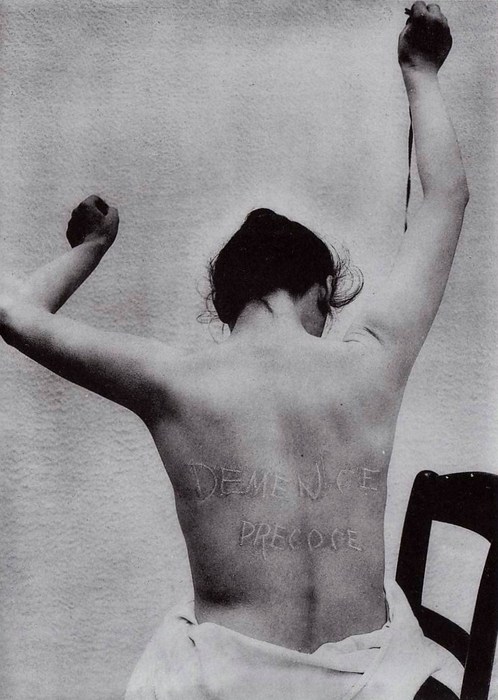
Dermographisme [aka dermographism, dermatographismm or “skin writing] – Démence précoce catatonique, from Nouvelle Iconographie de la Salpêtrière, Paris, 1904.

“Language is understood by Merleau-Ponty according to the self enfolding of the flesh. Language is not dependent on any voice but is what gives voice to the world itself. He writes that “language is everything since it is the voice of no-one, since it is the very voice of the things, the waves and the forests.” Language, in short, is the result of or is made possible by the dehiscence or folding back of the flesh of the world. [Invagination?]. In this sense language too is ‘another flesh’, another ‘wild being.’ Continue reading

Dark Writing

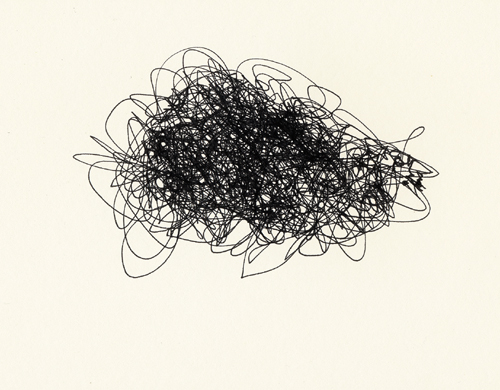
Klee_Line_for_a_walk

“Conspicuously left out of geography’s line – as it is left out of Descartes construction of the ‘I’- is of course the body that writes, and which, in writing, is also being written. Justine Clark explains:

The surface of the drawing is the site of involuntary traces, just as the scene of the body is the scene of involuntary muscular motions – blushing, tics, twitches – the play of internal effects across the surface of the body. If we follow Elizabeth Grosz’s contention that ‘all effects of depth and interiority can be explained in terms of the inscriptions and transformations of the subject’s corporeal surface…that the body can be understood as the very stuff of subjectivity,” then this surface of bruises and blushes, tingles and scars is crucial.”

Carter Paul, Dark Writing, University of Hawaii Press, 2009:pp.82. Image reproduced from http://rodcorp.typepad.com/rodcorp/rodcorps_art/page/2/

Landing Sites > Arakawa and Gins

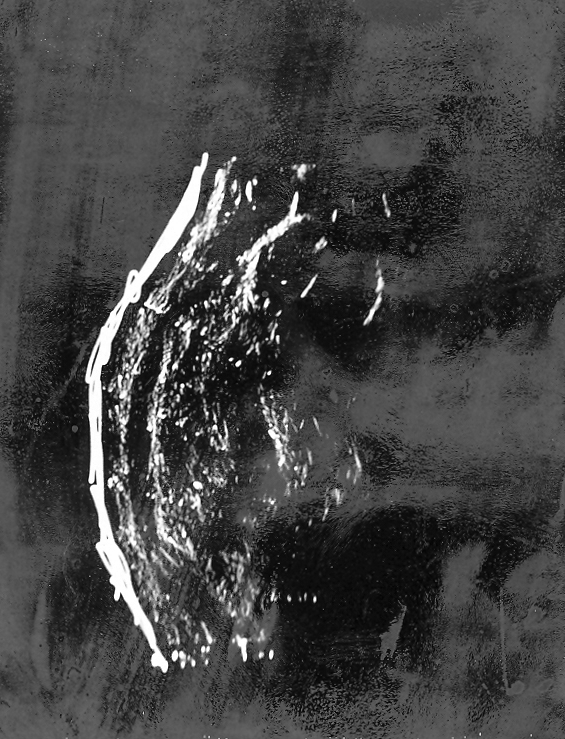
Shausaku Arakawa_Out of distance / Out of texture
[Distance of point blank B]

 “Were nothing being apportioned out, no world could form. What is being apportioned out no-one is able to say. That which is being apportioned out is in the process of landing. To be apportioned out involves being cognizant of sites. To be cognizant of a site amounts to having greeted it in some manner or to having in some way landed on it. There is that which gets apportioned out as the world. There is an apportioning out that can register and an apportioning out that happens more indeterminately. A systematic approximating of how things are apportioned out should be possible.

The body is sited. As that which initiates pointing, selecting, electing, determining and considering, it may be said to originate (read cooriginate) all sites. Organism-person-environment consists of sites and would-be sites. An organism-person, a sited body, lives as one site that is composed of many sites.”

For more information about the work of the artist Arakawa and Madeline Gins, artist, architect, poet and their architectural poetics in The Mechanism of Meaning please click here

Text reproduced from Architectural Body, Chapter 2 Landing Sites, MadelineGins and Shausaku Arakawa, The University of Alabama Press, USA 2002:pp.5

Image reproduced from http://nga.gov.au/international/Catalogue/Detail.cfm?IRN=74725&ViewID=2&GalID=ALL