“Performativity” Butler says “is construed of that power of discourse to produced effects through re-iteration, to produce what it declares.” Performativity however, is only possible within the constraints of “iterability.” We are spoken more than we speak, done more than we do; therefore we are “constrained by what remains radically unthinkable” and, in the area of sexuality “by the radical unthinkability of desiring otherwise”. Inhabiting a sexed position then always engages citational practices, “citing the law under and through the force of prohibition and taboo, with the threat of ostracism and even death compelling and controlling the shape of production but without fully pre-determining it.” “Agency” then, according to Butler’s reconfiguration, is always “on drugs”. It is always under the influence of language and can only take place within our reiteration of the reiterable. Continue reading
Critical Fragments
Subjects of dispersal
‘Foucault uses the language of space to highlight the formative effects of discourse and the instability of the plane it constitutes. Foucault’s analytics and politics are inextricably linked to creating an alternative physics of space. His alternative spatial text-ure both represents itself as a more accurate depiction of the real work of power and shifts the paradigmatic grounds for conceiving power. Power has generally been conceived as a dichotomous structure pairing intent and result, cause and effect, oppressor and oppressed. But Foucault levels the dimensionality of the social edifice, making power, knowledge, and subjects alike the temporary internal effects of a dispersed, evanescent field. The subject loses its organic solidity to appear like a bubble within a perpetually plastic substance. Subjects appear ‘in-different’ neither casually prior to a power’s mechanism, not imaginative outside its perpetually [re]formative web: Continue reading
Performative Installation
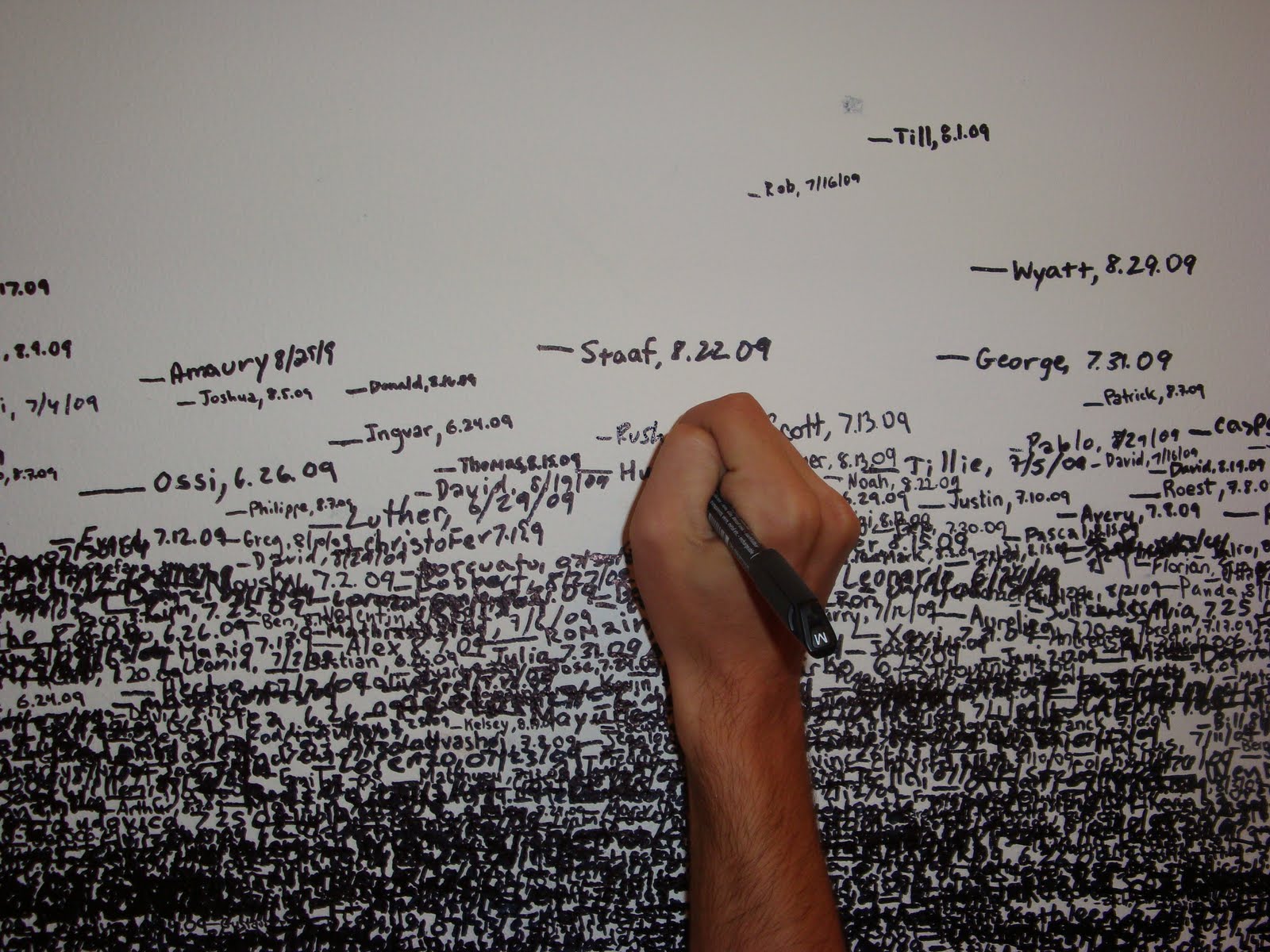
- The event aspect of performativity [the moment, now] is linked to the materiality of an installation in through simultaneousness of action/experience, or the event aspect of artistic production [performance] continues to take effect within the installation.
- Performativity is a constitutive part of the installation
- The installation alone is what generates the performativity
- A Performance Installation has its own individual context; by means of the performative elements it embraces the live elements of the external context and thereby incorporates categories from everyday routine and life.
- The extent of the performativity of an installation in terms of its appearance cannot be completely predicted or controlled here. Performative Installation thus unites within itself presence and representation, ephemeral and static elements, event and duration and immateriality and materiality. The direct effect and the indirect work enter into a synthesis. In a Performative Installation the dialectics of subject and object are annulled. Both are given a new common identity here.
Text quoted from performative installation, Angelika Nollert, 2003:pp.13
Image reproduced from http://artjetset.com/2009/08/30/roman-ondak-performative-installation-at-moma-2/. For more information about the work at MOMA 2009 click here
J.L Austin
‘Austin writes that the performative utterance must constitute the action that it describes or states:
‘to utter the [performative] sentence…is not to describe my doing in what I should be said in so uttering to be doing or to state that I am doing it: it is to do it‘ i,e I now pronounce you man and wife. Thus […] the uniqueness of the performative utterance lies not in its efficacy but in the fact that it is dependent on the self-referentiality of the utterance, its explicit reference to itself.’ pp12
Austin and Benveniste agree that in order for an utterance to be effectively performative it must occur under the appropriate circumstances. For Austin [1975] the circumstances are appropriate if those involved [speaker, listener, witnesses] view them as conforming to the traditions and conventions of society. Benveniste [1966] merely writes that a performative statement, in order to be authentic, must be uttered under contextual conditions that are themselves perceived as valid.’pp19
In ‘What is a Speech Act? [1971, 46-53], John Searle articulates a number of conditions in decribing ‘how to promise’ and suggests how they might be generalized to apply to other explicitly perofrmative speech acts. The most important among them are related to the authority of the speaker to make the statement under the circumstances in which it is made; the speaker’s sincerity and the listener’s belief in the plausibility of the predicated proposition. Once can effectively promise only what one intends to do and is capable of doing.’ pp19
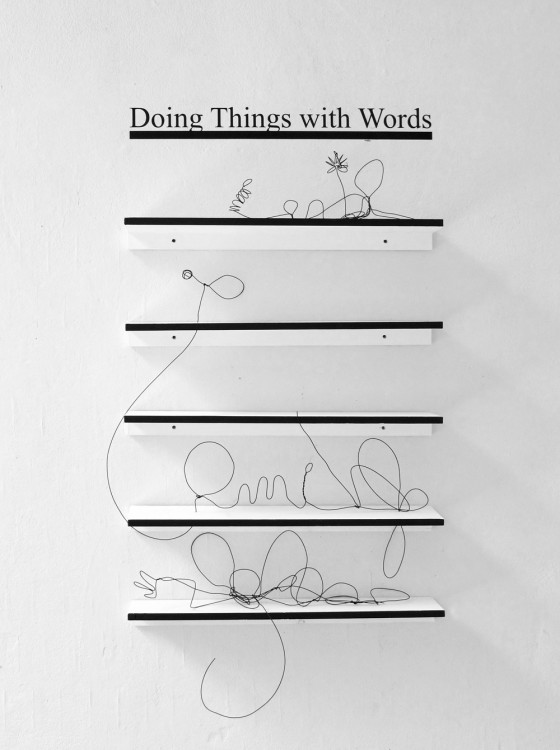
For further reading with regard to the illocutionary, the perlocutionary, the constative, the performative etc see J L Austin How to do things with words
Text reproduced from Performance in the Texts of Mallarme, Shaw, Mary Lewis 1993:pp12
Image reproduced from http://www.tamarinnorwood.co.uk/about/
Framing and Identity in Conceptual Poetics
At the recent Conceptual Poetics Symposium at the Poetry Center of the University of Arizona the key word seemed to be “framing.” The idea that words could be objectified to erase the identity of the writer–or to redefine what writing is–was explored through the notion of arrangement. This aesthetic sees words as objects to be placed in various structures through “language games” and distinguishes itself from an aesthetic in which the writer arranges the words as they represent his or her experience. In Conceptual Poetics, its practitioners argue, writing is freed from the limitations of one subjective viewpoint–the “lyric I” of confessional or romantic writers. Words are out there for anyone to place into “formal constraints.” What I found most interesting was the idea of subjectivities–the notion of replacing the “Lyric I” with several points of views or eyes looking out through various frames. The tools of technology allow poets to release the poem from the printed page and create hybrids with art, music, video games–whatever suits the “eye’s” fancy. To paraphrase one of the poets as he framed his chin and top of his head with his hand, what do we do with this space? The gesture conveyed visually that “this space” is a place from which to look out, not to look within. Continue reading