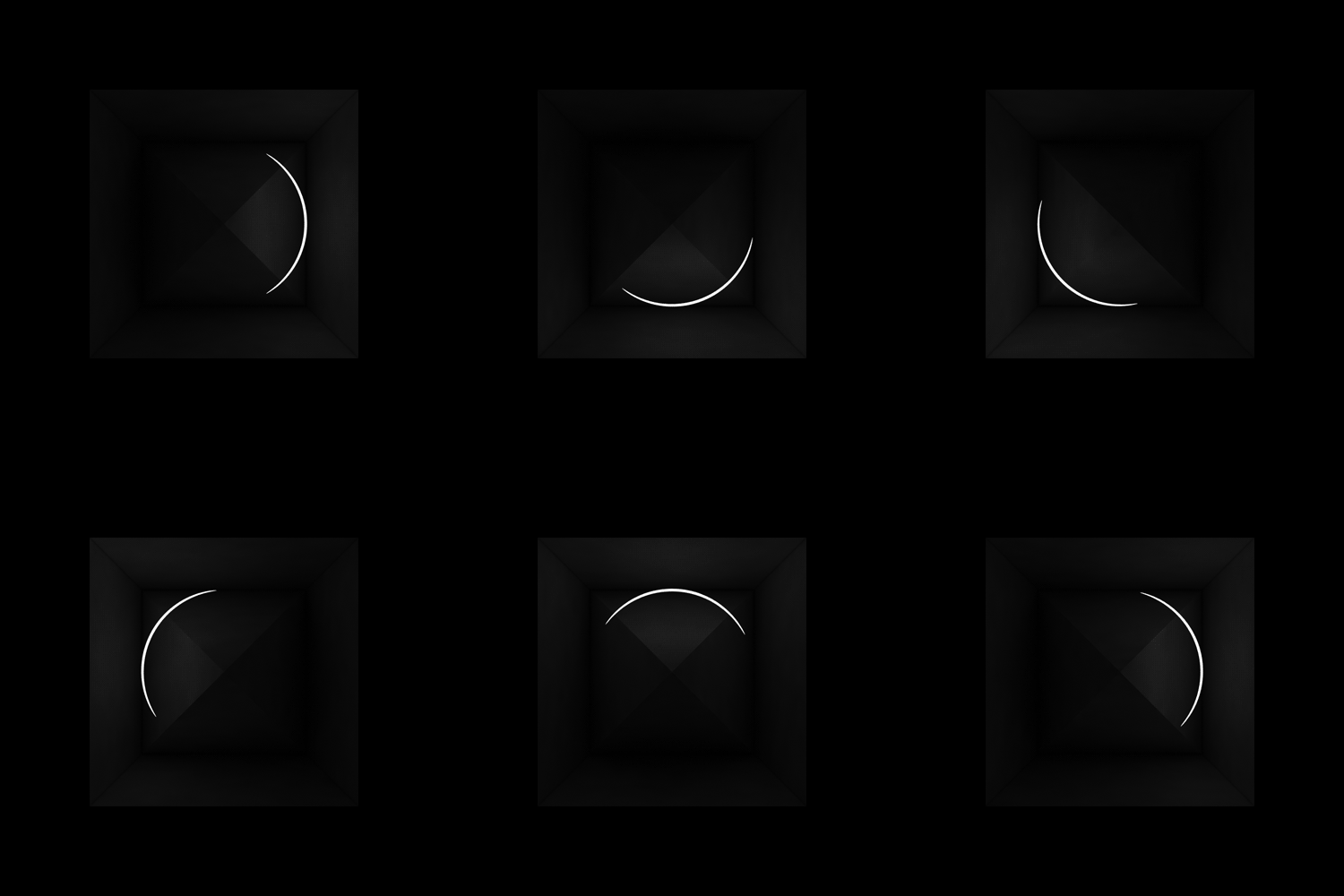
Gif reproduced from the Change the Thought, visit for more and if that’s not enough see Love Gifs or visit the visual china town of David Ope. Prepare to be mesmerised by a contemporary versions of Duchamp’s Rotorelief.
Gif reproduced from the Change the Thought, visit for more and if that’s not enough see Love Gifs or visit the visual china town of David Ope. Prepare to be mesmerised by a contemporary versions of Duchamp’s Rotorelief.

La combe II, 1950–51. Ellsworth Kelly
Ellsworth Kelly is among the most important protagonists of colour field painting. His paintings, in large format for the most part and consisting usually of several panels, are an impressive interplay of form, colour and space. Kelly’s works are notable for their very lean imagery: the forms are geometric or organic, the contours are drawn sharply, the colours are intense. Form, derived from real observation, is at the source of kelly’s creative process. The window of a museum, the floor of a paris café, the diagonal shadow of a garage entranceway – fragments of everyday reality that the artist translates into the simplest, most memorable forms, hence turning the quotidian into two-dimensional signs. Kelly does not find refuge in invented lines or shapes and is therefore liberated from the need to compose an image: “the things that interested me were always there”.
For more images of Ellsworth Kelly: black and white click here.
Text and image reproduced from www.artnews.org

Marcel Broodthaers Un Coup de des 1969
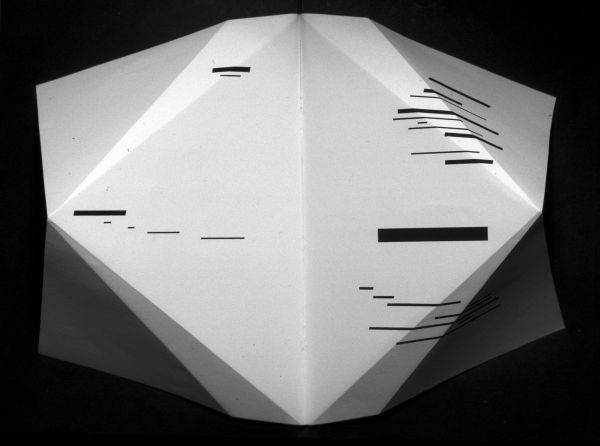
Alexandra Leykauf 2009
In 1969 Broodthaers re-staged Mallarme’s Un coup de des, to which Broodthaers added the title ‘(image)’. Replacing the lines of Mallarme’s poem with black rectangular blocks positioned and sized according to Mallarme’s instruction of the poem Broodthaers punctuates the space of the oversized page with a cool clinicism and translates the poem into a field of hard edged precision and fixed geometric forms.
Taking the line as an isolated visual unit, Broodthaers adheres to Mallarme’s injunction in ‘The Book: A Spritual Instrument. ‘Let us have no more of those successive, incessant back and forth motions of our eyes, tracking from one line to the next and beginning all over again. ‘(image)’ emphasizes the spatial dimensions of language while eliminating its reference. With this thorough illegibility, Broodthaers thus establishes what Jaques Derrida would call ‘a text, that is a readability without a signified.’
Robert Smithson also habitually equated words and rocks with a geololinguistics predicated on the realization that written language is an object with the same brute physicality of stone. Works such as the visual poem A Heap of Language (1966) and the ‘geophotographic fiction’ Strata 1970 embody this belief that […] writing should generate ideas into matter. Smithson reiterates elsewhere that he was interested in language as a material entity, later explaining that: ‘My sense of language is that it is matter and not ideas – i.e ‘printed matter.’
All text quoted from Fugitive_signs Craig Douglas Dworkin October, Vol. 95. (Winter, 2001), pp. 90-113. Images reproduced from Covers and Citations
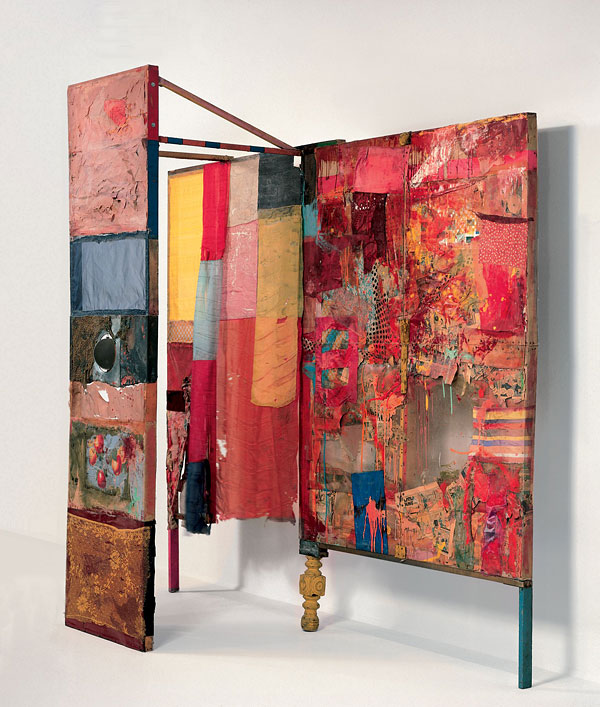
Minutiae, 1954 Freestanding combine Oil, paper, fabric, newspaper, wood, metal, plastic with mirror, on wooden structure, 214.6 x 205.7 x 77.4 cm
From the beginning, the artist has proclaimed: “I want to incorporate into my painting any objects of real life.” (Interview with André Parinaud, op.cit.) Although close in spirit to Dadaism and Schwitters’ use of discarded objects as a creative principle, Rauschenberg distinguishes himself through the dimensions of his works; very large, they invade the viewer’s space. “I would like to make a painting and a situation that leaves as much space for the person looking at it as for the artist.” (ibid.)
Whereas in a Picasso collage, the object or the heterogeneous material is inserted into the framework of the composition, in the Combines, the objects are simultaneously caught in the web that integrates them and are highly recognizable, and as such are rejected. All pictorial illusions and the idea that an artwork has only one meaning are thwarted. “In Rauschenberg’s work, the image depends not on the transformation of an object, but rather on its transfer. Taken from its place in the world, an object is embedded in the surface of a painting. Far from losing its material density in this operation, it asserts, to the contrary and insistently, that the images themselves are a sort of material.” (Rosalind Krauss, “Rauschenberg and the Materialized Image”, in L’originalité de l’avant-garde et autres mythes modernistes [French translation of The Originality of the Avant-garde and Other Modernist Myths (1985)], Macula, 1993). This observation holds for all Rauschenberg’s work, whether it involves an image or an art photo, a shirt or a tyre. Continue reading

Robert Rauschenberg, Pledge 1968
Image reproduced from http://takethepicturenow.wordpress.com/2009/07/28/art-history-26/
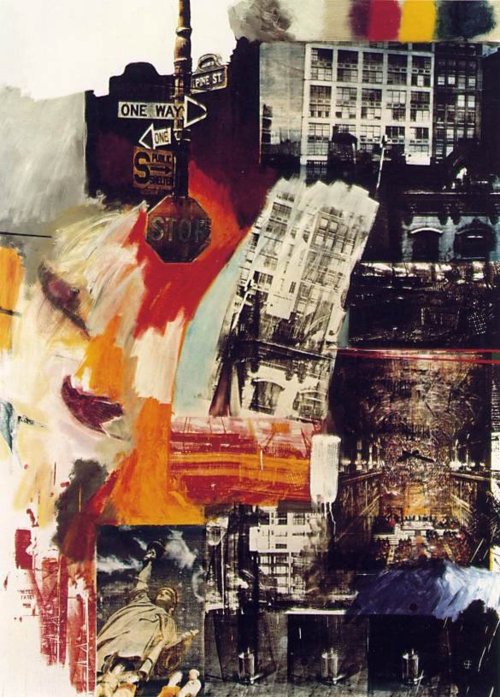 Image reproduced from http://pianoimpro.tumblr.com/post/11688260019/a-piano-improvisation about-robert-rauschenbergs
 denisestartin.co.uk