J.L Austin

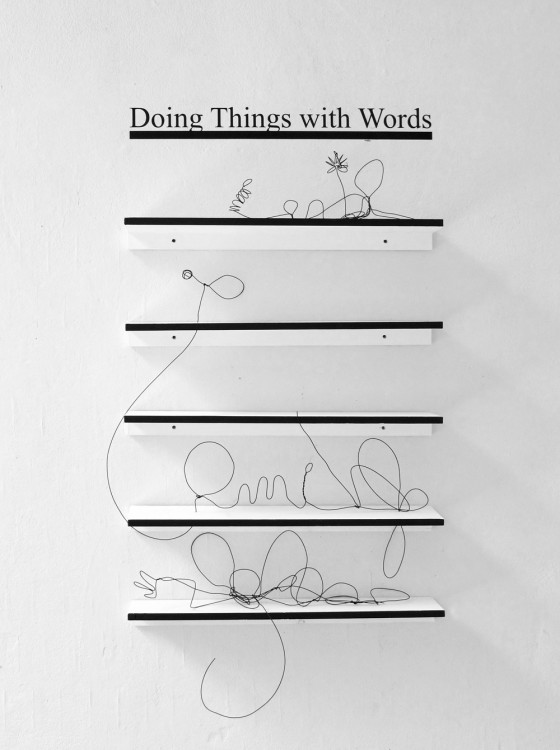
Tamarin Norwood Doing Things with Words

‘Austin writes that the performative utterance must constitute the action that it describes or states:

‘to utter the [performative] sentence…is not to describe my doing in what I should be said in so uttering to be doing or to state that I am doing it: it is to do it‘ i,e I now pronounce you man and wife. Thus […] the uniqueness of the performative utterance lies not in its efficacy but in the fact that it is dependent on the self-referentiality of the utterance, its explicit reference to itself.’ pp12

Austin and Benveniste agree that in order for an utterance to be effectively performative it must occur under the appropriate circumstances. For Austin [1975] the circumstances are appropriate if those involved [speaker, listener, witnesses] view them as conforming  to the traditions and conventions of society. Benveniste [1966] merely writes that a performative statement, in order to be authentic, must be uttered under contextual conditions that are themselves perceived as valid.’pp19

In ‘What is a Speech Act? [1971, 46-53], John Searle articulates a number of conditions in decribing ‘how to promise’ and suggests how they might be generalized to apply to other explicitly perofrmative speech acts. The most important among them are related to the authority of the speaker to make the statement under the circumstances in which it is made; the speaker’s sincerity and the listener’s belief in the plausibility of the predicated proposition. Once can effectively promise only what one intends to do and is capable of doing.’ pp19

For further reading with regard to the illocutionary, the perlocutionary, the constative, the performative etc see J L Austin How to do things with words

Text reproduced from  Performance in the Texts of Mallarme, Shaw, Mary Lewis 1993:pp12

Image reproduced from http://www.tamarinnorwood.co.uk/about/

Stephen Mallarmé

Stephen Mallarme ‘all words must efface themselves before sensations’

Beyond Reading

‘The pure work implies the elocutory disappearance of the poet, who abandons the initiative to words mobilised by the shock of their inequality; they light one another up with mutual reflections like a virtual trail of fire upon precious stones reflecting the breathing perceptible in the old lyrical blast of the enthusiastic personal direction of the phrase.’

the unit of the work cannot be the sentence, or the phrase, or the line

the linear syntax causes

the line, the phrase, the sentence

to be systematic, sequential

the unit of the work is the

word

Text reproduced from Some forms of availability, Critical passages on The Book by Simon Coutts:pp 160-173. Quotations from Crise de Vers 1888-96

Image reproduced from http://www.bradfordonavonmuseum.co.uk/archives/3269

Josef Albers

Josef Albers: Structural Constellation, c. 1950–60, drawing, photograph mounted as transparency (Josef and Anni Albers Foundation)

‘There is no world without a stage and no-one lives for not appearing

Seeing of eyes invites to speak

Knowing of eyes invites to show

Notice also, silence sounds

Listen to the voice of colour

Semblance proves it can be truth

As every form has sense and meaning.’

Text quoted from Josef Albers, Despite straight lines:pp.8

Image reproduced from http://aauerbach.info/research/structural_constellations/index_fig_3.html

John Latham

John Latham Time based roller 1972

The rollers, or blind paintings, made between 1963-67, were an attempt by the artist to physically embody time in painting.  “Latham adopted the roller format because it enabled him to represent time as a passing effect and time as a state which does not change, to encapsulate the relationship between the present moment and a whole event (a life or a universe): if the rectangle of canvas represents a whole event, then the narrow strip of canvas exposed along the roller represents the present moment. When the canvas is rolled up, the whole event is still there but hidden from view.”
(John A. Walker, ‘John Latham, The Incidental Person’, Middlesex University Press, 1994)

In 1972 Latham made the Time-Base Roller (now in the Tate Collection), three lengths of canvas along a 6m long cylinder. This time he included a numbered spectrum along the horizontal axis of the Roller, with a ‘least event’ represented at Band 1 on the left hand edge, and the universe as event at Band 36 on the right. Between these two extremes, the spectrum allows for the understanding of all cosmological, geological or spiritual phenomena, all physical, emotional or psychological states within the same system.

Text reproduced from http://www.flattimeho.org.uk/project/31/

Image reproduced from http://www.tate.org.uk/servlet/ViewWork?cgroupid=999999961&workid=83954&searchid=9838&roomid=false&tabview=image&imageid=357256